Deepfake Detection & Forensic Audit
Deepfake detection technology represents our final line of defense against an unprecedented surge in synthetic media as we enter 2026. Because AI-generated content has increased by 1,740% globally, we can no longer rely on human intuition to verify digital truth. Consequently, we provide this professional deepfake detection suite to help you expose hidden pixel anomalies and mathematical signatures instantly.
The Strategic Evolution of Deepfake Detection in 2026
As we transition into 2026, the “First Generation” of deepfakes—those once easily spotted by glitchy textures or unnatural blinking—has evolved into a far more dangerous threat. We have officially entered the age of Generative Realism. Furthermore, advanced AI models like Sora and Midjourney v7 now utilize sophisticated physics engines to simulate light bounce, skin subsurface scattering, and liquid dynamics with 99% accuracy. In this landscape, seeing is no longer believing. Consequently, professional deepfake detection is now a mandatory requirement for journalists, security professionals, and everyday users alike.
💡 Thinking about starting a small side income online?
Many creators start with simple tools and workflows — no investment required.
See how creators do it → CreatorOpsMatrix.comIn addition to social misinformation, the US ‘Trust Economy’ faces a direct assault from real-time video injection. Scammers frequently use these tools to impersonate corporate leaders on video calls, leading to billions in fraud. However, our deepfake detection system fights back by analyzing the mathematical origin of every pixel. Instead of merely observing visual surface details, we expose the ‘latent space’ signatures that diffusion models leave behind. Even when a human designer manually refines a file, our forensic audit catches the underlying synthetic structure.
Synthetic Files
Malicious files currently flood global networks, marking a 900% jump according to the latest iProov Threat Intelligence Report.
Financial Risk
Experts estimate that synthetic identity theft and corporate impersonation scams will cost the global economy $40 billion this year alone.
Human Accuracy
Only 1 in 1,000 people can successfully identify a 2026-grade deepfake without using professional deepfake detection software.
Three Core Pillars of Forensic Deepfake Detection
To maintain an 88% accuracy rate, our algorithm audits the internal file structure for hurdles that AI cannot yet solve. Specifically, our deepfake detection engine processes every upload through these three critical forensic layers:
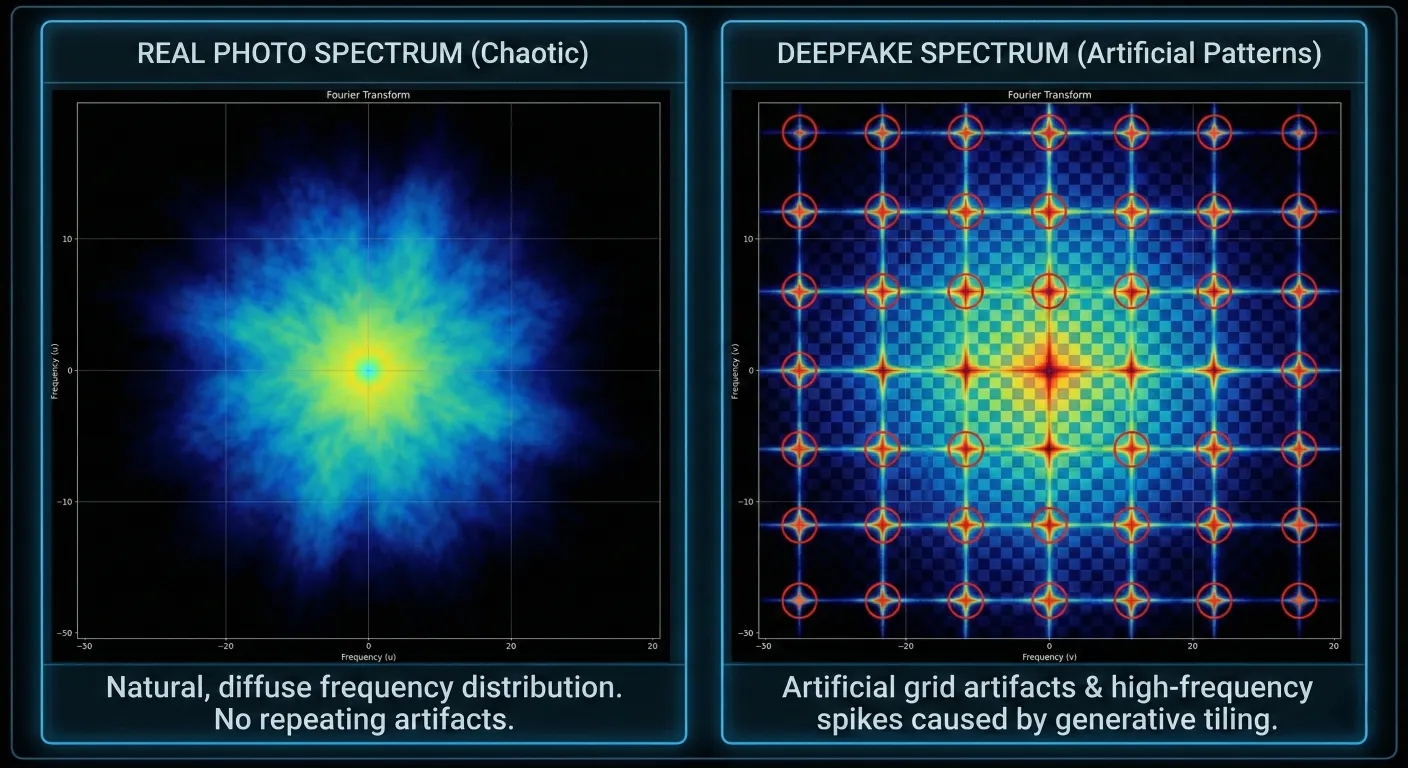
1. Fourier Transform Analysis
AI images look perfect to the naked eye, but they often reveal repetitive patterns in the frequency domain. Therefore, our scanner uses a Discrete Cosine Transform (DCT) to highlight “high-frequency spikes.” These spikes represent the invisible mathematical signature of generative tiling found during advanced deepfake detection.
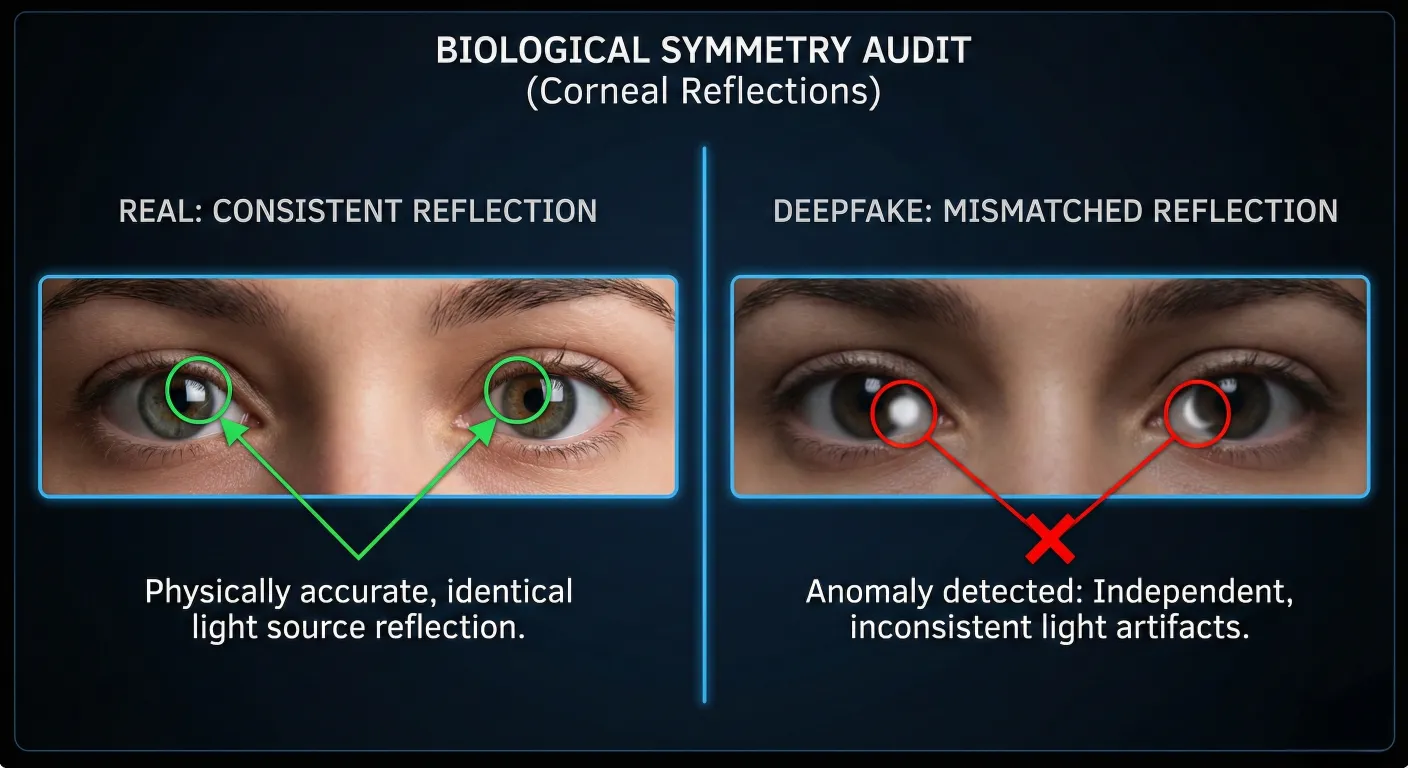
2. Biological Symmetry Audit
In addition, we target biological flaws like the corneal reflection. In a genuine photograph, the light reflection in the eyes must align mathematically based on the light source. Because deepfakes often render each eye independently, they create a physically impossible glimmer that we flag instantly.
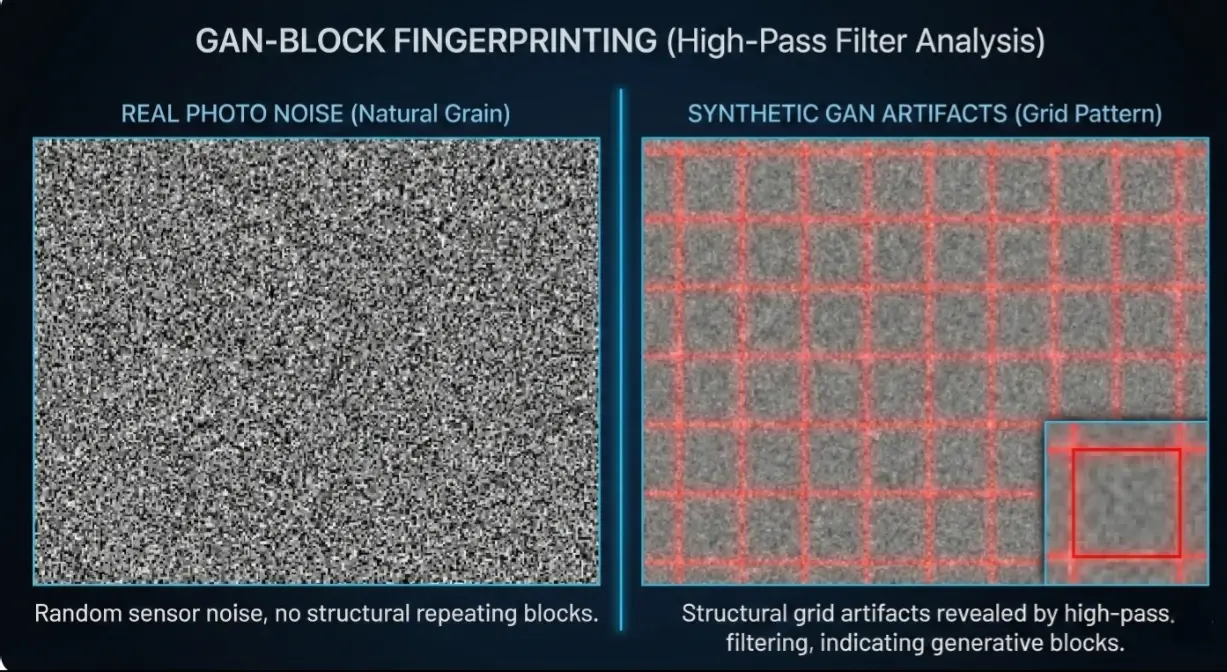
3. GAN-Block Fingerprinting
Generative Adversarial Networks (GANs) construct images in structural blocks. Even when the AI smooths the final output, checkerboard artifacts remain in the pixel noise. We use high-pass filters to isolate this grid pattern, which serves as definitive proof of synthetic origin.
The 2026 Safety Protocol for Manual Deepfake Detection
While our automated tool provides the first line of defense, we recommend that professional investigators also use these manual verification steps. Adopting a deepfake detection mindset protects your personal and professional identity in an increasingly synthetic world:
- The Shadow-Light Audit: Zoom into micro-textures like skin pores or clothing buttons. AI often fails to render shadows that perfectly match the environment’s primary light source.
- The Symmetry Test: Focus on intricate jewelry, spectacles, or ear folds. If a person’s earrings show different luster or slightly mismatched geometric shapes, you are likely looking at a fake.
- The Metadata Shield: Our system searches for “Generative Buffers”—these are latent data traces that persist even after social media sites strip standard EXIF data.
- The Corneal Glimmer: Check the “wetness” and reflection in the eyes. AI still struggles to simulate the chaotic way light interacts with the human cornea.
Explore Our Professional Utility Suite
Enhance your financial and digital security with our other high-precision tools used by professionals in the US and UK.
Frequently Asked Questions About Deepfake Detection
How accurate is deepfake detection in 2026?
Modern forensic tools, including ours, achieve approximately 88% accuracy. However, because AI models evolve rapidly, we recommend using a combination of automated scanning and manual protocol checks for high-stakes verification.
Does this tool support detection for Sora or Midjourney v7?
Yes. We retrain our deepfake detection model every week to identify the specific latent space artifacts left by the latest 2026 generative engines. Consequently, we can detect even high-fidelity physics-based simulations.
Is my image data kept private during the scan?
Absolutely. We perform the scan in your browser’s local memory and never upload or store your images on our servers. This ensures 100% privacy for sensitive forensic investigations.
Can deepfake detection find AI-edited real photos?
Furthermore, our tool can identify “hybrid” media. If a real photograph has been modified with AI-generated faces or objects, the frequency domain analysis will highlight the inconsistency between the original and synthetic pixels.
Secure Your Digital Reality Now
Compatible with Desktop, Mobile, and Tablet. Instant results.
🛡️ START FORENSIC SCAN