DP-600 Direct Lake Performance Optimization
Direct Lake is the highest-impact DP-600 topic for performance questions. This guide covers the OneLake vs SQL endpoint decision, every fallback trigger, all three DirectLakeBehavior settings, Delta table optimization with V-Order and Z-Order, DAX patterns for Direct Lake, capacity guardrails per F-SKU, and 18 exam-style questions with full explanations.
Direct Lake reads Delta-Parquet files from OneLake directly via VertiPaq — no data import, no per-query SQL. It appears in DP-600 under ‘Implement and manage semantic models’ (25–30%), specifically: configure Direct Lake including default fallback and refresh behavior; choose between Direct Lake on OneLake and Direct Lake on SQL endpoints; improve DAX performance; implement performance improvements in queries and report visuals. (per official DP-600 Skills Measured, April 20, 2026)
What Direct Lake Is and Why It Matters for DP-600
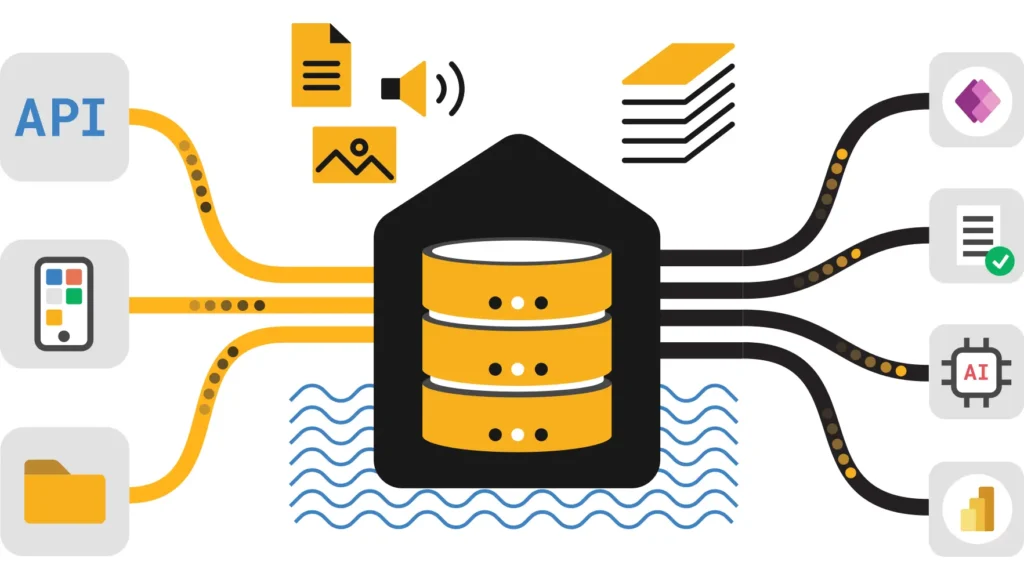
Power BI has three storage modes. Import copies data into the VertiPaq in-memory engine — fast queries, but a refresh cycle that means reports can be hours behind the source. DirectQuery runs a live SQL query against the source on every report interaction — always current, but slow for large datasets. Direct Lake sits between the two.
Direct Lake reads Delta-Parquet files directly from OneLake using the VertiPaq engine. No data copy. No per-query SQL translation. VertiPaq frames the Delta files — mapping them into its in-memory column store format — and then serves queries from that framing at near-Import speed. When the underlying Delta files change, VertiPaq re-frames automatically. Reports stay current without an import refresh cycle.
This is why Direct Lake is the highest-impact storage mode for large-scale analytics in Fabric, and why it appears prominently in the DP-600 exam under Optimize enterprise-scale semantic models. The exam tests whether you can choose the right configuration, diagnose why Direct Lake fell back to DirectQuery, and design Delta tables that keep VertiPaq performing at its best.
Direct Lake Availability — F64 Minimum for Production
Direct Lake requires a Fabric capacity. For production workloads at enterprise scale, F64 is the recommended minimum. Smaller F-SKUs (F2, F4, F8, F16, F32) support Direct Lake but with tighter row count and file count limits. The DP-600 exam tests capacity guardrail knowledge — know the limits for F64, F512, and F1024.
OneLake vs SQL Endpoint — The Core DP-600 Architecture Decision
The most frequently tested Direct Lake design question in DP-600: should you connect your semantic model to Direct Lake on OneLake, or to Direct Lake via a SQL endpoint? The answer determines your fallback risk profile completely.
✅ Direct Lake on OneLake
- VertiPaq reads Delta files directly from OneLake storage
- No SQL layer in the data path
- Zero SQL-based fallback triggers
- Supports 10B+ row fact tables at F1024
- Security managed at OneLake item level
- Predictable sub-second performance
- Choose when: You control the Lakehouse design and can manage security with OneLake item-level permissions
⚠️ Direct Lake via SQL Endpoint
- SQL analytics endpoint sits between VertiPaq and Delta files
- Introduces SQL-specific fallback triggers
- Row-Level Security defined in SQL causes fallback
- Non-materialized views cause fallback
- Supports complex SQL RLS and warehouse security
- Performance depends on fallback frequency
- Choose when: Existing SQL RLS or complex view logic cannot be removed
| Decision Factor | OneLake | SQL Endpoint | DP-600 Answer |
|---|---|---|---|
| SQL-based fallback risk | None — no SQL layer | RLS and views can trigger it | OneLake for strict SLA |
| Row count scalability | 10B+ rows at F1024 | Best under 1.5B at F64 | OneLake for very large tables |
| Row-Level Security | OneLake item-level only | Full SQL RLS supported | SQL endpoint if SQL RLS required |
| View support | Materialized views only | Non-materialized views risky | Prefer materialized views either way |
| Security complexity | Simpler — item-level | Complex — SQL grants + RLS | OneLake unless SQL RLS is mandatory |
| Performance predictability | Always VertiPaq | Depends on fallback frequency | OneLake for consistent response times |
The DP-600 exam presents this as a scenario: “A team has a 2.5 billion row fact table in a Fabric Lakehouse. Power BI reports are intermittently slow. Investigation shows DirectQuery fallback is occurring.” The correct answer path: the table exceeds F64 guardrails, OR Row-Level Security defined in the SQL endpoint is triggering fallback, OR the connection is via SQL endpoint with non-materialized views. The fix: connect directly to OneLake, ensure the table is under the F-SKU row limit, or upgrade the capacity.
Every Direct Lake Fallback Trigger — What Causes It and How to Fix It
Understanding every fallback trigger is the most important Direct Lake exam skill. Fallback is silent by default — the report just gets slower. The exam presents symptoms and expects you to identify the cause.
| Fallback Trigger | Via OneLake? | Via SQL Endpoint? | Fix |
|---|---|---|---|
| Row-Level Security defined in SQL | No — not applicable | Yes — causes fallback | Switch to OneLake connection, or implement RLS in Power BI semantic model instead of SQL |
| Non-materialized views | No — not applicable | Yes — causes fallback | Replace non-materialized views with materialized views, or materialize the view result as a Delta table |
| Row count exceeds F-SKU limit | Yes | Yes | Upgrade F-SKU, archive old partitions, or split very large tables |
| Parquet file count exceeds limit | Yes | Yes | Run OPTIMIZE to consolidate small files. Target <200 files per partition. |
| Unsupported column data types | Yes | Yes | Cast to supported types in the Silver/Gold transformation layer before the data reaches the semantic model |
| Complex query features VertiPaq cannot process natively | Yes | Yes | Simplify DAX. Push complexity into the Gold layer as pre-calculated columns rather than on-the-fly DAX computation. |
Critical: Fallback Still Happens When DirectLakeBehavior = DirectLakeOnly — for Capacity Breaches
When a Direct Lake table exceeds F-SKU row count or file count limits, Fabric falls back to DirectQuery even when DirectLakeBehavior is set to DirectLakeOnly. Capacity guardrail breaches override the behavior setting. This is a common DP-600 trick question: “A team set DirectLakeBehavior to DirectLakeOnly but reports are still slow. Why?” — Answer: the table exceeded the F-SKU row or file count limit, triggering a capacity-forced fallback that the behavior setting cannot override.
DirectLakeBehavior — The Three Settings and When to Use Each
DirectLakeBehavior is a semantic model-level property. It controls what the engine does when a query would normally fall back from Direct Lake to DirectQuery. DP-600 tests all three settings with scenario-based questions — know which setting to choose given the business requirement.
| Setting | What Happens on Fallback | Use When | DP-600 Exam Signal |
|---|---|---|---|
| Automatic | Silently falls back to DirectQuery. Query succeeds but is slower. | Exploratory analytics where occasional slow queries are acceptable. Analysts prefer an answer over an error. | Question uses words like “must never fail” or “user experience must not be interrupted” → Automatic |
| DirectLakeOnly | Returns an error instead of falling back. Query fails visibly. | Production environments with strict SLAs where slow fallback is worse than failure. Forces issues to surface in testing before production. | Question uses words like “predictable performance,” “SLA,” “errors should be visible during testing” → DirectLakeOnly |
| DirectLakeOrEmpty | Returns an empty result set instead of falling back. No error, no data. | Regulatory dashboards where showing incorrect/stale data is more harmful than showing blank. Used when a security policy change is mid-update. | Question uses words like “data correctness over availability,” “blank is better than wrong data” → DirectLakeOrEmpty |
Delta Table Optimization for Direct Lake — V-Order, Z-Order, OPTIMIZE
Direct Lake performance starts at the Delta table level. A semantic model reading poorly structured Delta files will underperform regardless of how well the DAX is written. Three Delta-level optimizations are tested on DP-600.
V-Order — Column-Store Compression
V-Order is a Microsoft-specific optimization applied when writing Parquet files. It rearranges data within each Parquet file to be more column-store friendly — tighter dictionary encoding, better compression, higher VertiPaq cache hit rates. V-Order is applied by the Spark engine in Fabric by default for Delta tables created through Fabric Notebooks and Dataflow Gen2. It can also be applied explicitly via OPTIMIZE.
Z-Order — Co-locate Related Data
Z-Order re-clusters data on specified columns — typically the join keys used in your semantic model (CustomerKey, ProductKey, DateKey). Co-locating similar key values in the same Parquet files means VertiPaq can skip more files when filtering, making predicate pushdown more efficient.
Row Group Sizing
Per Microsoft Learn, optimal row group size for Direct Lake is 1 million to 16 million rows, with approximately 4 million as the practical target. Too small: metadata overhead increases. Too large: individual segments become expensive to cache. The 4M row target balances compression ratio against cache granularity.
OVERWRITE is Expensive for Direct Lake — Prefer MERGE or APPEND
OVERWRITE invalidates existing segment metadata and dictionaries. VertiPaq must rebuild the dictionary mapping the next time the table is framed, increasing CPU cost and temporarily pushing columns to Cold residency. For production Gold tables feeding Direct Lake semantic models, use incremental MERGE or APPEND patterns. Reserve OVERWRITE for initial loads or full rebuilds during maintenance windows.
DAX Performance Patterns for Direct Lake Semantic Models
Delta table optimization handles the storage side. DAX optimization handles the query side. These patterns apply specifically to Direct Lake where VertiPaq reads from Delta files rather than imported data — the engine behavior is similar but the fallback risk means inefficient DAX can compound into fallback triggers.
Replace Text Keys with Integer Surrogate Keys
Text columns create large dictionaries — every distinct value must be stored and tracked. Integer surrogate keys (CustomerKey as INT vs CustomerName as VARCHAR) have dictionaries 10–100× smaller. Smaller dictionaries: more data stays in VertiPaq cache, joins complete faster, memory pressure drops.
Use Predicate Pushdown — Filters Before Aggregation
Apply filters at the visual or page level (slicers, page filters) rather than wrapping large tables in FILTER() inside measures. Direct Lake can skip entire Parquet files when filters are applied early — a visual-level filter that eliminates 80% of data means 80% fewer segments are read before aggregation starts.
Start with Simple Aggregations Before Iterators
SUM(), COUNT(), AVERAGE() map directly to storage engine queries that Direct Lake handles efficiently. SUMX(), COUNTX(), and other X-function iterators create row-by-row evaluation that forces more segment reads. Build the measure with a simple aggregation first; add iterators only when business logic requires them and no storage engine alternative exists.
Hybrid Tables for RLS-Heavy Dimensions
Keep very large fact tables in Direct Lake mode. Load sensitive, security-complex dimensions in Import mode. Import mode supports complex Row-Level Security, calculated columns, and user-friendly hierarchies without affecting Direct Lake performance on the main fact table. The VertiPaq engine handles both modes within the same semantic model.
The performance difference between a SUM and a SUMX is negligible on a 1,000-row table. On a 500 million-row Direct Lake fact table, a SUMX that row-iterates becomes a capacity issue. The DP-600 exam expects you to recognize when calculated columns should be built in the Gold transformation layer vs computed at query time in DAX. Move computation left — closer to data load time, not report render time.
Capacity Guardrails — Row Limits, File Limits, and What Happens When You Exceed Them
Every F-SKU has Direct Lake guardrails. Exceeding them triggers forced fallback to DirectQuery regardless of DirectLakeBehavior setting. DP-600 expects you to know these limits and how to stay under them.
| F-SKU | Max Rows per Table | Max Parquet Files | Memory | Recommended Use Case |
|---|---|---|---|---|
| F2–F16 | ~300M rows | ~1,000 files | 3–6 GB | Development, POC, small departmental models |
| F32 | ~600M rows | ~2,500 files | 12 GB | Small production models, pilot workloads |
| F64 | ~1.5B rows | ~5,000 files | 25 GB | Departmental fact tables. Minimum recommended for production Direct Lake. |
| F256 | ~6B rows | ~8,000 files | 100 GB | Large enterprise models — multi-year transaction history |
| F512 | ~12B rows | ~10,000 files | 200 GB | Enterprise-wide star schemas at scale |
| F1024 | ~24B rows | ~10,000 files | 400 GB | Global, petabyte-scale analytics models |
Staying Under Guardrails in Production
- Archive historical partitions: Move data older than your reporting window (e.g., 3 years) to archive tables. The semantic model Gold table only covers the active analytical period.
- Run OPTIMIZE regularly: Consolidates small files from incremental loads into fewer, larger Parquet files. Keeps file count well below the F-SKU limit. Schedule after each pipeline run on high-volume tables.
- Monitor file count before each load: If file count approaches the F-SKU limit, run OPTIMIZE before adding new data. Do not wait for the guardrail to be hit in production.
- Partition by low-cardinality attribute: Partitioning by YearMonth keeps per-partition file counts low and makes archiving straightforward — drop an old partition rather than deleting rows.
Monitoring Direct Lake Performance — DMV, Residency, and the Metrics App
Column Residency — Hot, Warm, Cold, SemiWarm
VertiPaq tracks whether column segments are in memory (Hot), partially loaded (Warm/SemiWarm), or on disk (Cold). Hot columns serve queries without storage I/O. Cold columns require segment reads from OneLake on each query — slower and more expensive at capacity scale.
High-traffic columns — foreign keys, date keys, and frequently filtered attributes — should show Hot or Warm residency. If critical join keys are Cold, the model is reading from storage on every query. Fixes: increase capacity (more memory available for VertiPaq cache), reduce the column count in the model (fewer columns competing for cache), or partition more aggressively to reduce the data volume VertiPaq needs to frame.
Fabric Capacity Metrics App
The Capacity Metrics App shows Direct Lake framing operations as separate CU charges. A spike in framing CU consumption after a pipeline run indicates the semantic model is re-framing frequently — common when Automatic Updates is enabled during heavy ETL activity. Consider disabling Automatic Updates during large pipeline loads and triggering a single manual refresh when the load completes. For the complete Metrics App monitoring guide, see our Capacity Optimization Guide.
Automatic Updates — Enable vs Disable
Automatic Updates causes the Direct Lake semantic model to re-frame shortly after the underlying Delta tables change. For tables updated every few hours, this is efficient. For tables with continuous micro-batch updates (Eventstream or Mirroring with 30-second latency), Automatic Updates can cause dozens of framing operations per hour — each consuming CUs. Disable Automatic Updates on continuously updating tables and schedule a single refresh on a business-appropriate cadence instead.
18 DP-600 Direct Lake Exam Questions — With Full Explanations
These questions mirror the scenario-based format of the DP-600 exam. Each question presents a situation and expects you to choose the correct technical response.
FAQ – DP-600 Direct Lake Performance Optimization
Official References and Related UIG Guides
Official Microsoft Documentation
Related UIG Data Lab Guides
⚠️ Accuracy Disclaimer
All exam domain percentages and skill topics are sourced from the official DP-600 skills measured document (updated April 20, 2026). Capacity guardrail figures are sourced from Microsoft Learn — Understand Direct Lake query performance. Microsoft updates exam content and capacity limits periodically — verify current values before your exam date. UIG Data Lab is an independent publication, not affiliated with or endorsed by Microsoft Corporation.