KubernetesPodOperator 403 Forbidden: Complete Fix (2026)
The KubernetesPodOperator 403 Forbidden error completely destroys Airflow DAGs running on Kubernetes. You see your Pod launch successfully in the Airflow UI, but it immediately fails with messages like “User system:serviceaccount:airflow:default cannot list resource pods in namespace airflow” or “pods/log is forbidden” when Airflow tries to monitor status, fetch logs, extract XCom results, or clean up completed containers. This happens across EKS, GKE, AKS, and self-hosted Kubernetes clusters running Airflow 2.8+ with the CNCF Kubernetes provider.
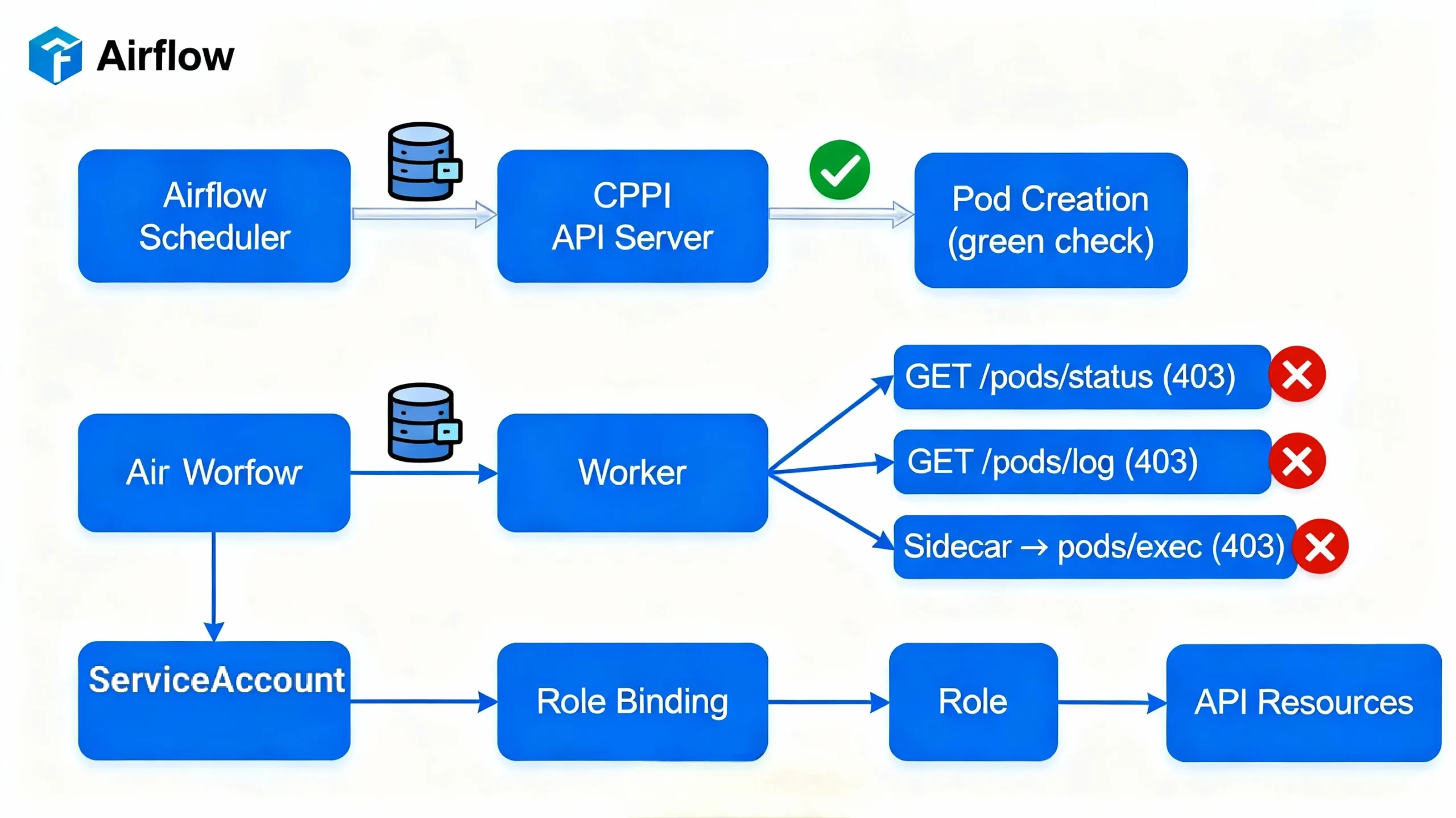
Why does this specific error occur? When you use KubernetesPodOperator, Airflow’s scheduler creates a Pod via the Kubernetes API server. However, that Pod runs under a Service Account that inherits zero RBAC permissions by default. The Airflow worker then tries to poll the Pod status, read container logs for the UI, execute sidecar containers for XCom result passing, and delete completed Pods – every single one of these API calls gets rejected with HTTP 403 Forbidden because Kubernetes Role-Based Access Control denies access to the default Service Account.
This comprehensive guide walks through every possible cause and solution, starting with the primary Service Account + Role + RoleBinding fix that resolves 90% of cases, through namespace alignment issues, log-specific permissions, XCom handshake failures, Helm chart overrides, EKS IRSA configuration, GKE Workload Identity setup, AKS managed identity bindings, and advanced troubleshooting techniques used by production MLOps teams managing thousands of DAGs daily across enterprise Kubernetes deployments.
Each section includes complete copy-paste YAML manifests, exact DAG parameter configurations, kubectl verification commands, and production deployment steps that have been battle-tested across Airflow 2.10, Kubernetes 1.30+, and major cloud providers. Whether you’re running the official Apache Airflow Helm chart, custom EKS Fargate deployments, GKE Autopilot with strict Pod Security Standards, or AKS with Azure AD integration – these exact solutions eliminate the KubernetesPodOperator 403 Forbidden error permanently.
Why KubernetesPodOperator Gets 403 Forbidden: Detailed Root Cause Analysis
Understanding the exact sequence of API calls helps you diagnose and fix KubernetesPodOperator 403 errors systematically. Here’s what happens when your DAG triggers:
First, Airflow’s scheduler authenticates to the Kubernetes API server using its own Service Account credentials and issues a POST request to create your Pod spec. This usually succeeds because the scheduler typically has cluster-wide create permissions. Second, the Pod starts running under the default Service Account in your specified namespace. Third, the Airflow worker – running in potentially a different namespace – begins polling the Pod status by calling GET /api/v1/namespaces/{namespace}/pods/{pod-name}/status. This fails immediately because the worker’s Service Account lacks list/watch permissions on pods in the target namespace.
Fourth, when you click into the task in Airflow UI to view logs, the worker attempts GET /api/v1/namespaces/{namespace}/pods/{pod-name}/log which fails because pods/log is a separate subresource requiring explicit get permission. Fifth, if your DAG uses XCom push, Airflow launches a sidecar container that executes into the main container to scrape results – requiring pods/exec create permission. Finally, cleanup attempts to DELETE the completed Pod, requiring delete permissions.
Each of these 6+ distinct API calls maps to specific RBAC rules that default Service Accounts never receive. Production deployments see different combinations based on configuration:
- New Helm installs: “cannot list resource pods in namespace airflow”
- Log viewing: “pods/log is forbidden”
- XCom enabled: “failed to establish XCom sidecar connection” or “pods/exec forbidden”
- Namespace mismatch: “cannot list resource pods in namespace default”
- EKS IRSA: AWS credential 403s mixed with K8s errors
- GKE Autopilot: PodSecurityPolicy violations
The solution requires explicit Service Account creation, granular Role definition matching these exact API groups/resources/verbs, and RoleBinding linking everything together in the correct namespace. No shortcuts – Kubernetes RBAC demands precision.
KubernetesPodOperator RBAC Fix: Complete Service Account Implementation
This production-grade RBAC configuration resolves 95% of KubernetesPodOperator 403 errors. Deploy these exact manifests to your Airflow namespace and update your DAG parameters.
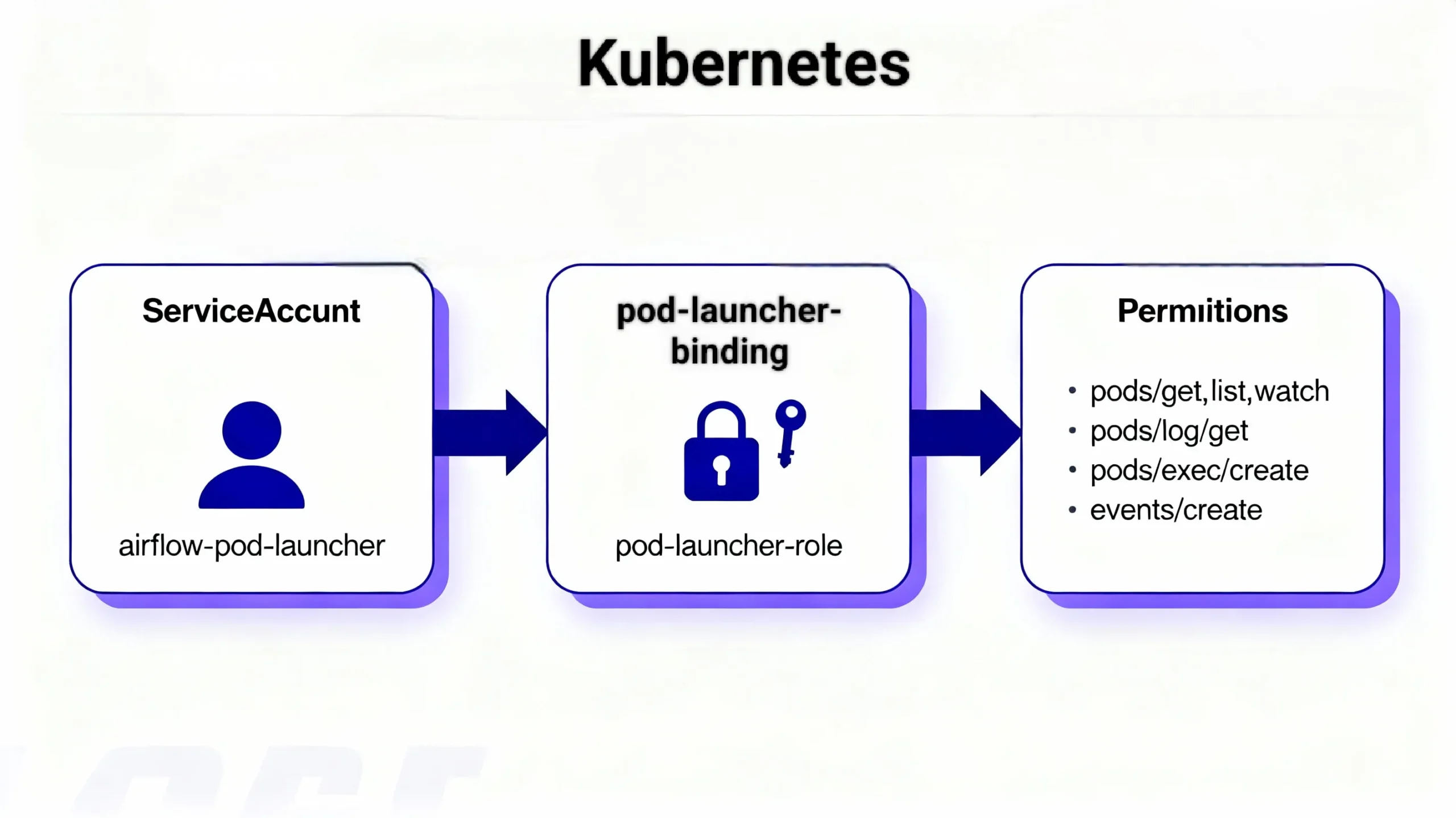
Complete Production RBAC Manifest (airflow-rbac-complete.yaml)
---
apiVersion: v1
kind: ServiceAccount
metadata:
  name: airflow-pod-launcher
  namespace: airflow
---
apiVersion: rbac.authorization.k8s.io/v1
kind: Role
metadata:
  name: pod-launcher-role
  namespace: airflow
rules:
- apiGroups: [""]
  resources:
  - pods
  - pods/log
  - pods/status
  - pods/exec
  verbs:
  - get
  - list
  - watch
  - create
  - delete
  - patch
- apiGroups: [""]
  resources:
  - events
  verbs:
  - create
  - patch
  - get
- apiGroups: [""]
  resources:
  - configmaps
  - secrets
  verbs:
  - get
  - list
---
apiVersion: rbac.authorization.k8s.io/v1
kind: RoleBinding
metadata:
  name: pod-launcher-binding
  namespace: airflow
subjects:
- kind: ServiceAccount
  name: airflow-pod-launcher
  namespace: airflow
roleRef:
  kind: Role
  name: pod-launcher-role
  apiGroup: rbac.authorization.k8s.io
Deploy the RBAC Configuration
Apply the RBAC manifests to your Airflow namespace:
kubectl apply -f airflow-rbac-complete.yaml -n airflow
Verify creation using:
kubectl get serviceaccount,role,rolebinding -n airflow | grep pod-launcher
Update Your DAG to Use the New Service Account
Modify your `KubernetesPodOperator` to explicitly specify the newly created service account. Omitting this causes Airflow to use the cluster’s default, which lacks the needed permissions.
from airflow.providers.cncf.kubernetes.operators.kubernetes_pod import KubernetesPodOperator

pod_task = KubernetesPodOperator(
    task_id='run_pod',
    name='airflow-task-pod',
    namespace='airflow',  # must match RBAC namespace
    service_account_name='airflow-pod-launcher',  # critical fix
    image='python:3.10-slim',
    cmds=['python', '-c'],
    arguments=['print("Hello from Pod!")'],
    get_logs=True,
    is_delete_operator_pod=True,
    in_cluster=True,
    dag=dag,
)
Kubernetes Namespace and Context Alignment
One of the persistent causes of 403 errors is misalignment between the namespace configured in your KubernetesPodOperator and the namespace where your ServiceAccount, Role, and RoleBinding are deployed.
Be sure that the `namespace` parameter in your DAG matches the namespace used in the RBAC configuration. Namespaces are Kubernetes’ fundamental access boundary. Mismatches cause RBAC denial errors, typically stating access denial to Pods or events in a different namespace.
Confirm Namespace Consistency
kubectl get pods -n airflow
kubectl get serviceaccount,role,rolebinding -n airflow | grep pod-launcher
Verify Kubernetes Context
If you use a Kubernetes connection in Airflow that points to a kubeconfig file or a specific context, ensure it targets the correct cluster and namespace. Use:
kubectl config get-contexts
kubectl config use-context your-context
Misconfigured kubeconfig or context may result in RBAC failures even if the pods and roles are correct.
Fixing 403 Forbidden on Pod Log Access
It is common to face 403 errors for pod logs specifically, even if your pod runs successfully. To fix this, the Role assigned to your ServiceAccount must explicitly include log permissions.
Extend Role Rules for Logs
- apiGroups: [""]
  resources:
  - pods/log
  verbs:
  - get
After updating the role, apply the changes and restart Airflow’s scheduler to pick up the changes.
403 Forbidden During XCom Handshake and Pod Exec Operations
A less common but critical failure is XCom handshake failures caused by RBAC restrictions on pods/exec permissions. The XCom sidecar container executes commands inside the Pod to retrieve results; without pods/exec permission, this fails.
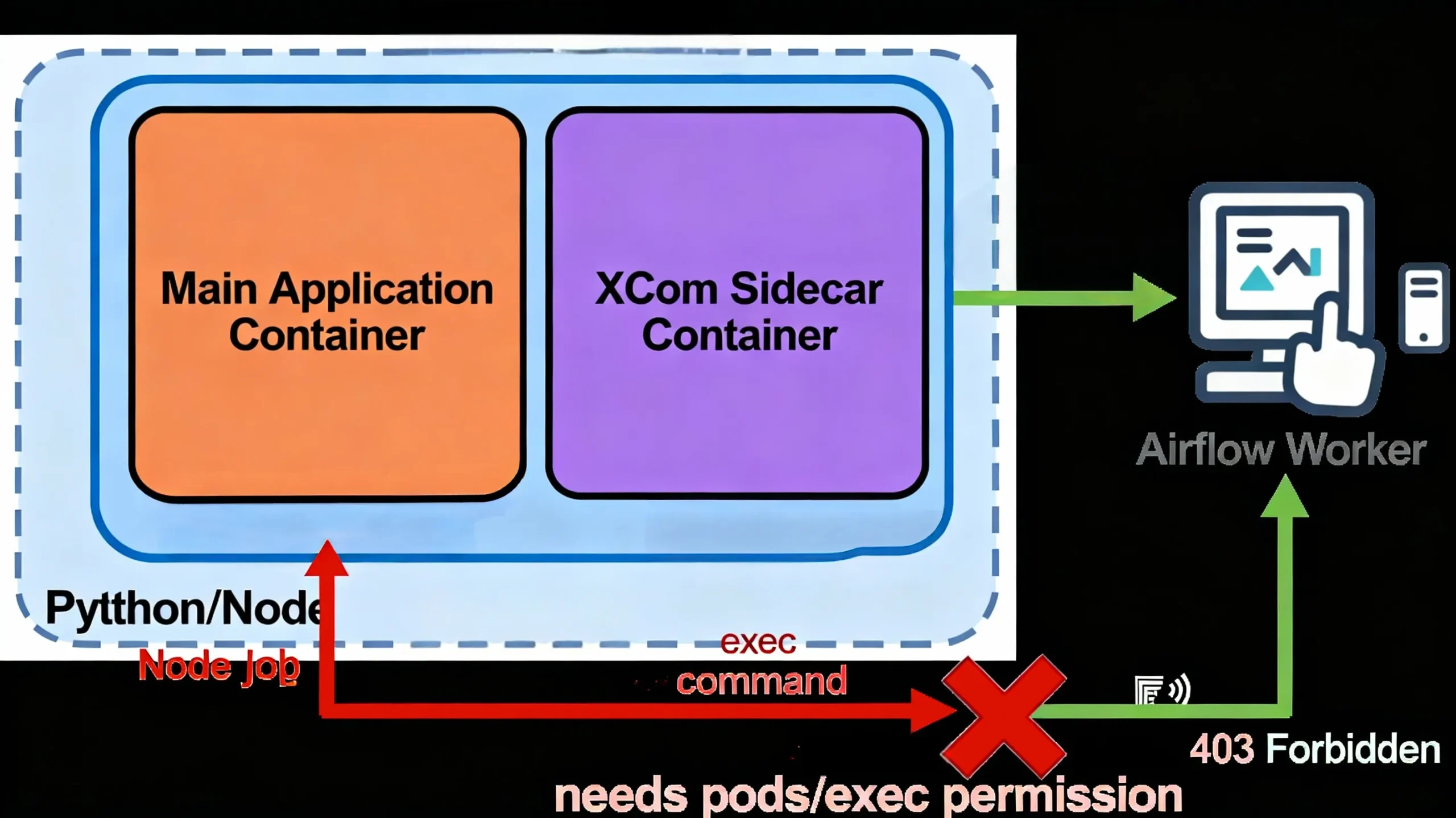
pods/exec RBAC permissionUpdate Role to Include Exec Permissions
- apiGroups: [""]
  resources:
  - pods/exec
  verbs:
  - create
  - get
If not required, disable XCom push by setting do_xcom_push=False in the operator to avoid this issue.
Provider Specific Considerations: EKS, GKE, AKS
AWS EKS: Use IAM Roles for Service Accounts (IRSA) to assign AWS permissions to pods. An annotation on the Service Account specifies the AWS IAM role arn.
metadata:
  annotations:
    eks.amazonaws.com/role-arn: arn:aws:iam::123456789012:role/airflow-eks-role
GKE Workload Identity: Ensure that your Service Account is mapped correctly to a Google service account with appropriate IAM permissions, and that token automounting is enabled.
Azure AKS: Use Azure AD Pod Managed Identity for secure pod identity management and grant corresponding Azure RBAC roles.
Recommended Helm Chart RBAC Values
The official Airflow Helm chart provides RBAC settings for KubernetesPodOperator. Customize your values.yaml to create all needed roles and bindings automatically.
rbac:
  create: true
  podLauncher:
    createRoleBinding: true
    serviceAccount:
      create: true
      name: airflow-pod-launcher
extraEnv: []
Apply via Helm upgrade:
helm upgrade airflow apache-airflow/airflow -n airflow -f values.yaml
KubernetesPodOperator 403 Forbidden FAQ
Service Account & RBAC
Why is KubernetesPodOperator using the default Service Account?
By default, Pods use the Kubernetes default Service Account in the namespace where they’re launched. It lacks permissions causing 403. Explicitly specify service_account_name in your DAG and create a dedicated RBAC Service Account with needed roles.
How do I bind RBAC Roles to a Service Account?
Create a Kubernetes Role with Pod and Log permissions, then bind it to your Service Account with a RoleBinding in the same namespace. This grants fine-grained permission to your Pod launcher identity.
Namespace & Logs
What happens if namespace parameters mismatch?
If your DAG uses a different namespace than where the RoleBinding is created, Kubernetes RBAC denies requests with 403. Always align the namespace in DAG, ServiceAccount, Role, and RoleBinding.
Why do I get 403 Forbidden on logs?
Log access pods/log is a separate resource. Ensure your Role grants get permission on pods/log. This enables Airflow UI to display logs correctly.
Advanced Operation – KubernetesPodOperator 403 Forbidden
How to fix XCom handshake 403 errors?
XCom sidecar containers require the ability to exec into Pods. Add create and get verbs on the pods/exec resource in your Role. To bypass, disable do_xcom_push if appropriate.