Microsoft Fabric IQ — Complete 2026 Guide
Ontology, Data Agents, Operations Agents, Graph, Planning, and the Build 2026 GA announcements — all verified against Microsoft official documentation through June 2026.
Microsoft Fabric IQ is the shared context layer inside Microsoft Fabric that unifies data, business meaning, and AI agent intelligence. At Build 2026 (June 2, 2026), Fabric IQ reached General Availability — including Operations Agents GA, Graph GA, and Planning GA (later in June). Ontology — the layer that maps business entities, relationships, and rules to live OneLake data — remains in Preview and is expected to reach GA in the coming months. Fabric IQ is now part of Microsoft IQ, the unified intelligence layer spanning Work IQ, Foundry IQ, Fabric IQ Ontology, and Web IQ — accessible across Microsoft Foundry, Copilot Studio, Microsoft Agent 365, and GitHub Copilot CLI.
Status Summary — June 2026
GA status for every Fabric IQ component as of the Build 2026 announcement (June 2, 2026).
| Component | Status | What It Does |
|---|---|---|
| Fabric IQ (overall) | GA — Build 2026 | Shared context layer for agents and real-time intelligence within Fabric |
| Operations Agents | GA — Build 2026 | Continuously monitor live data, apply semantic context, execute automated actions |
| Graph in Fabric | GA — Build 2026 | Relationship-first modelling engine for business entities and systems |
| Planning in Fabric | GA — June 2026 | Agent planning and reasoning layer; reached GA later in June 2026 |
| Fabric Data Agent | GA | Conversational NL-to-SQL/DAX/KQL query over governed OneLake data sources |
| Ontology (Fabric IQ) | Preview | Business entity, relationship, rule, and action definitions mapped to OneLake data |
| Data Agent — Service Principals | Preview — June 2026 | Authenticate data agents via app identities for backend and automated workflows |
| Data Agent — Preview Runtime (NL2SQL v2) | Preview — June 2026 | Opt-in preview of improved NL2SQL, higher query limits; matures into the default over time |
| Data Agent — Code Interpreter | Preview | Python execution inside data agents for forecasting, statistical analysis, transformation |
| Data Agent — Observability (Foundry) | Preview — June 2026 | Trace requests, monitor latency, debug agent failures from Microsoft Foundry |
| Creator Agent (SQL + Eventhouse) | Preview — June 2026 | AI-assisted data agent setup — generates and refines configurations interactively |
| Fabric IQ MCP (Copilot Studio) | Preview | Add Fabric IQ as a Tool when building agents in Copilot Studio via MCP |
Build 2026 GA Announcements — What Changed
Microsoft Build 2026 opened on June 2, 2026. The Fabric IQ announcements at Build represent the largest single status change for the platform since its introduction — moving from preview to GA for the core components, and extending integration across the entire Microsoft AI stack.
Fabric IQ — Generally Available
Fabric IQ as a whole reached GA at Build 2026, making the shared context layer available for production use. Operations Agents and Graph are GA now. Planning reaches GA later in June. Ontology remains in Preview with GA expected in the coming months.
Operations Agents — GA
Operations Agents are now generally available. They continuously monitor live data from OneLake and Real-Time Intelligence event streams, apply Ontology business context, and execute automated actions — moving beyond answering questions to driving outcomes at operational speed.
Graph in Fabric — GA
Graph in Fabric — the relationship-first modelling engine that maps connections between business entities and systems — reached GA at Build 2026. It provides a managed, queryable graph with automatic schema and data updates for dependency and impact analysis.
Planning in Fabric — GA (June 2026)
Planning in Fabric — the agent reasoning and task decomposition layer — reached GA later in June 2026. It enables agents to break complex multi-step tasks into structured plans before execution.
Microsoft IQ — Unified Intelligence Layer
At Build 2026, Microsoft launched Microsoft IQ — the unified intelligence layer combining Work IQ (M365 workplace context), Foundry IQ (enterprise knowledge retrieval), Fabric IQ Ontology (business semantics), and Web IQ (live web grounding). Fabric IQ Ontology is the data-platform component of this layer, accessible across Foundry, Copilot Studio, Agent 365, and GitHub Copilot CLI.
Data Agent Service Principals — Preview
Fabric Data Agents now authenticate via Entra ID service principals — no interactive user sign-in required. This unlocks backend services, automated workflows, and custom applications in Foundry, Copilot Studio, and MCP-based agent frameworks at enterprise scale.
Ontology is the most important layer in Fabric IQ for enterprise use — it defines business entities, relationships, and rules that ground all agent reasoning. As of Build 2026 (June 2, 2026), Ontology remains in Preview. Microsoft’s official language is “expected to be generally available in the coming months following Build 2026.” There is no specific date in the official documentation. Do not design production systems that require Ontology to be GA until the GA announcement is made.
What Is Microsoft Fabric IQ
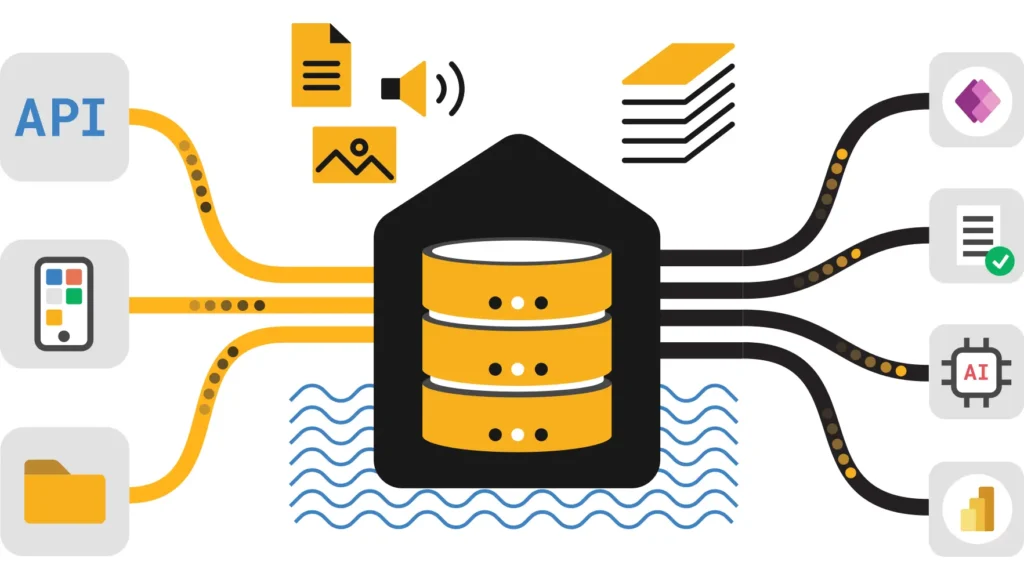
Fabric IQ is the shared context layer inside Microsoft Fabric. It sits between raw data in OneLake and the AI agents, analysts, and applications that need to act on it. Without a shared context layer, every agent starts from zero — relearning business terminology, table structures, and relationships each time. Fabric IQ addresses this by maintaining a persistent, governed, always-current understanding of how the business works and what the data means.
The platform brings together three interrelated systems: the Ontology (business entity definitions, relationships, and rules), the agent types that use that context (Data Agents for conversational Q&A, Operations Agents for autonomous action), and the graph and planning engines that enable relational reasoning and multi-step task execution.
| Problem Without IQ | How Fabric IQ Addresses It |
|---|---|
| Agents relearn business context on every query — no shared understanding of terms, tables, or relationships | Ontology defines business entities, relationships, and rules once; all agents inherit that context automatically |
| Different teams use different definitions of the same metric (revenue, customer, order) — reports conflict | Ontology centralises certified definitions; Power BI semantic binding enforces them across all reports |
| AI agents can answer questions but cannot take action — humans must still intervene for every decision | Operations Agents monitor live signals and execute automated actions based on Ontology business rules |
| Business users cannot query data without SQL knowledge — data teams become bottlenecks | Fabric Data Agent translates natural language to SQL, DAX, or KQL using governed OneLake sources |
| Understanding relationships between entities requires manual joins across dozens of tables | Graph in Fabric models entity relationships explicitly, enabling traversal and impact analysis without joins |
A June 2026 Forrester report cited in Microsoft’s Build 2026 announcements states that “AI fails without context-rich data. No matter how well modelled, data without the context provided by shared semantics and mature ontologies will fall short for agentic AI use cases.” That framing is accurate in practice — the teams seeing real production value from AI agents are the ones where data has structure, lineage, and agreed-upon business meaning, not just the ones with the most data. Fabric IQ is a bet that the bottleneck for enterprise AI in 2026 is context, not model capability.
Ontology — The Operational Context Layer Preview
The Ontology is the central item in Fabric IQ. It connects data, processes, rules, and actions into a unified semantic layer — elevating raw tables and event streams into business-ready concepts that both people and AI agents can understand and use consistently. As of Build 2026, Ontology remains in Preview with expanded capabilities and integrations introduced at FabCon Atlanta (March 2026) and Build 2026 (June 2026).
Ontology Constructs
Entities
Business objects — Customer, Order, Product, Flight, Subscription. A single entity can represent multiple tables and columns across different data sources while hiding that complexity behind a clean business concept that both humans and agents understand.
Relationships
How entities connect — a Customer places many Orders; an Aircraft is assigned multiple Flights. Relationships become graph edges in Graph in Fabric, enabling traversal and impact analysis without SQL joins.
Rules and Actions
Business logic and policies stored directly in the Ontology — when a condition is true, an alert fires or an automated action executes. This feature allows automation without custom code or switching between tools. Integrates with Fabric Activator for event-driven execution. Refer to the Rules in ontology documentation.
Attributes and Semantic Lineage
Descriptive properties linked to entities — Customer Name, Order Total, Flight Departure Time. Every concept traces to the exact data source in OneLake, providing full auditability for compliance and governance.
March 2026 (FabCon) and June 2026 Additions
Fabric IQ Ontology now supports sharing and permissions management for Ontology items. Workspace owners can control who can access and collaborate on specific ontologies, enabling enterprise governance of the semantic layer itself — not just the data it references.
The Ontology runs on a managed, queryable graph with automatic schema and data updates. This enables instant exploration of dependencies, impact paths, and patterns across the business model without manual graph maintenance.
Ontology integrates with Operations Agent to continuously monitor business goals, surface insights against those goals, and recommend actions — all grounded in the Ontology’s entity types and relationships. Operations Agent uses Ontology context to interpret live signals from Fabric Real-Time Intelligence in business terms, not raw metric values.
Fabric Data Agent — Conversational Analytics GA
The Fabric Data Agent enables any user in an organisation to ask business questions in plain English and receive answers grounded in governed OneLake data. It translates natural language into SQL, DAX, or KQL, executes those queries against permitted data sources, and returns structured, human-readable responses. It does not bypass permissions — every query runs with the requesting user’s credentials enforcing least-privilege access.
How the Data Agent Processes a Question
- Parse and validateThe question is checked against security protocols, Responsible AI policies, and user permissions before any query is generated.
- Source routingThe agent identifies the most relevant of its configured data sources (up to five) based on schema and metadata. Updated in June 2026 Preview Runtime with improved multi-source routing accuracy.
- Query generationThe appropriate tool generates the query — NL2SQL for Lakehouses and Warehouses, NL2DAX for Power BI semantic models, NL2KQL for KQL databases (including user-defined functions, live and historical event data), or Microsoft Graph for organisational data.
- Query validationThe generated query is validated for syntactic correctness and policy compliance before execution. Microsoft Purview DLP and access restriction policies apply throughout this lifecycle.
- Response formattingResults are formatted into a structured, human-readable answer. With Code Interpreter enabled (Preview), Python execution adds charts, forecasting, and statistical analysis on top of query results.
June 2026 Data Agent Updates
Service Principal Authentication Preview
Data Agents authenticate via Entra ID service principals — no interactive user sign-in. Backend services, automated workflows, and custom applications in Foundry, Copilot Studio, and MCP frameworks can now call Data Agents securely at scale.
Preview Runtime — NL2SQL v2 Preview
Opt-in preview runtime with improved NL2SQL, higher query result limits, and enhanced multi-source routing. These changes mature into the default over time. Switch between Standard and Preview runtime in the Data Agent settings. Model upgrades to GPT 5.X models across both runtimes — approximately 20% accuracy improvement in internal benchmarks.
Code Interpreter Preview
Python execution inside Data Agent responses. Enables forecasting, statistical analysis, and data transformation beyond what SQL results alone can answer. Combines NL2SQL query results with Python computation in a single response.
Observability via Microsoft Foundry Preview
Trace each Data Agent request in Microsoft Foundry — see latency per step, identify where queries slow down or fail, and monitor reliability as data and user question patterns change over time.
Creator Agent (SQL + Eventhouse) Preview
AI-assisted setup experience for Data Agents. Generates and refines agent configurations through a guided interactive workflow — replacing manual schema annotation and configuration. Available for SQL and Eventhouse data sources.
Visualisations in Data Agents Coming Soon
Chart and visual output directly inside Data Agent responses. Currently in development — announced as coming soon at Build 2026 as the next capability in the agent response format roadmap.
The Fabric Data Agent enforces read-only access across all configured data sources — it cannot write, update, or delete data. It supports up to five data sources per agent instance. All queries execute with the requesting user’s credentials (or service principal credentials), meaning the agent can only access data the requester is already authorised to see. Microsoft Purview DLP and access restriction policies apply throughout the query lifecycle.
Operations Agent — Autonomous Business Actions GA — Build 2026
Operations Agents are the proactive counterpart to Data Agents. Where a Data Agent waits for a user to ask a question, an Operations Agent monitors live data streams continuously, applies business context from the Ontology, and executes automated actions when defined conditions are met — without a human prompt.
Operations Agents run on the governed foundation of Fabric and are integrated with Microsoft Foundry. They connect to live signals from Fabric Real-Time Intelligence event streams, interpret those signals in business terms using Ontology entity types and relationships, and take action through Fabric Activator alerts, automated workflows, or API calls.
Data Agent vs. Operations Agent
Data Agent — Conversational
- Reactive — waits for a user question
- Translates natural language to SQL, DAX, or KQL
- Returns a structured answer or analysis
- Read-only across governed OneLake data sources
- Access controlled by requesting user’s credentials
Operations Agent — Autonomous
- Proactive — continuously monitors live signals
- Interprets signals using Ontology business context
- Executes automated actions when conditions trigger
- Integrates with Fabric Activator and Foundry for action execution
- Suitable for operational scenarios where human approval loops are impractical
The Operations Agent GA is the component that makes Fabric IQ an operational platform rather than an analytics platform. The distinction matters for deployment planning: Data Agents need governed data and clear business questions. Operations Agents need live event streams, a well-defined Ontology with rules, and clear answers to “what should the agent do when this condition is true” before any production deployment. The Ontology rules configuration — still in Preview — is what determines whether an Operations Agent behaves predictably. GA of Operations Agents does not mean the rule authoring experience is production-ready for all scenarios yet.
Graph & Planning in Fabric
Graph in Fabric GA — Build 2026
Graph in Fabric is the relationship-first modelling engine that maps connections between business entities and systems. It runs as a managed, queryable graph database with automatic schema and data updates — removing the need to maintain custom graph infrastructure. Use Graph in Fabric when the questions being asked are inherently relational: Which customers are at risk because their preferred suppliers are failing? Which downstream reports depend on this upstream table? Which systems are affected if this entity changes?
The Ontology exposes entity relationships as graph edges, making Graph in Fabric the queryable surface for traversing and analysing those relationships. Dependency exploration, impact analysis, and pattern detection across the business model are the primary use cases.
Planning in Fabric GA — June 2026
Planning in Fabric enables AI agents to decompose complex, multi-step tasks into structured plans before executing them. Rather than generating a single response to a question, a planning-enabled agent breaks the task into steps, identifies the data and tools needed at each step, executes them in order, and reconciles intermediate results. Planning reached GA later in June 2026 following the initial Build 2026 announcements.
Fabric IQ Across the Microsoft Ecosystem
One of the most significant changes at Build 2026 is how broadly Fabric IQ is now integrated — it is no longer contained within the Fabric workspace. As of June 2026, Fabric IQ is accessible from every major Microsoft AI surface.
| Surface | Integration | Status |
|---|---|---|
| Microsoft Foundry IQ | Fabric IQ is unified with Work IQ, Azure SQL, File Search, and MCP behind one SLA-backed retrieval endpoint. Agents built in Foundry can tap Fabric data without custom RAG pipelines. | GA |
| Microsoft Agent 365 | Fabric IQ integrated as a first-party MCP tool. Enterprise governance and observability applied to ontology-grounded agents across M365. | GA |
| Microsoft 365 Copilot (Cowork, Copilot Chat) | Fabric IQ grounds Copilot responses in governed Power BI reports and semantic models — users get answers grounded in certified enterprise data without leaving Copilot. | Available |
| GitHub Copilot CLI | Agent Skills for Fabric bring Fabric IQ context to the terminal. Developers query reports and semantic models directly from GitHub Copilot CLI without switching to a browser. | Available |
| Copilot Studio | Low-code agent builders add Fabric IQ MCP as a Tool when creating agents. Ontology provides business context so Copilot Studio agents understand organisational data. | Preview |
| Power BI Semantic Binding | Certified metrics and definitions managed by IQ Ontology bind to Power BI reports, enforcing consistent KPI definitions across all visualisations. | Available |
Governance and Production Readiness
Fabric IQ’s agent capabilities require governance to maintain trust. The more autonomously agents act — particularly Operations Agents — the more critical it is that the Ontology definitions are accurate, versioned, and change-controlled.
| Governance Area | Fabric IQ Mechanism | Why It Matters for Production |
|---|---|---|
| Ontology ownership | Sharing and permissions management for Ontology items (March 2026) | Controls who can modify entity definitions and rules that drive agent behaviour |
| Change approval | Review-before-merge workflows integrated with Fabric CI/CD and Git | Prevents unreviewed Ontology changes from affecting production agents immediately |
| Agent observability | Foundry Observability — per-request tracing, latency monitoring, failure analysis (Preview, June 2026) | Provides the audit trail needed to diagnose agent failures and demonstrate compliance |
| Data access control | Entra ID, least-privilege credentials, Microsoft Purview DLP on all query lifecycles | Agents cannot access data the requesting identity is not authorised to see |
| Sensitivity labels | OneLake sensitivity labels from Microsoft Purview apply when exposing Ontology data | Regulated data classification flows through to agent responses |
| Service principal governance | Service principal auth for Data Agents (Preview, June 2026) | Eliminates interactive sign-in dependencies; principal rotation via Azure Key Vault; execution logged under principal identity for compliance |
- Ontology rules are reviewed and approved — an incorrectly defined rule causes an Operations Agent to take the wrong automated action in production with no user intervention
- Action execution scope is explicitly bounded — define which systems the agent can call and what actions it can take; use Fabric Activator for alert-based actions and separate API permissions for write actions
- Observability is configured before go-live, not after an incident — Foundry Observability tracing must be enabled so failures are diagnosable from the first production run
- Test in a staging environment with production-equivalent data — behaviour differences between dev and prod data are the most common cause of Operations Agent misfires
Getting Started with Fabric IQ
The correct starting point depends on which component is most relevant to your current use case. Data Agent is the fastest path to visible value for most teams — it requires no Ontology and is GA. Operations Agents require Ontology rules configuration, which is still in Preview.
Path 1 — Start with Fabric Data Agent (Fastest, GA)
- Ensure your data is in OneLake as governed Delta tablesThe Data Agent sources from Lakehouses, Warehouses, Power BI semantic models, and KQL databases. Tables must be registered and accessible — raw Files are not queryable by the agent.
- Create a Data Agent in your Fabric workspaceNavigate to New item → Data agent. Use Creator Agent (Preview) for SQL and Eventhouse sources to auto-generate the configuration via AI-assisted setup.
- Connect up to five data sourcesSelect Lakehouses, Warehouses, semantic models, or KQL databases. Provide schema documentation notes where table names or column names are ambiguous — this directly improves NL2SQL accuracy.
- Enable Preview Runtime for improved NL2SQL (optional)Switch to the Preview Runtime in Data Agent settings to access the improved NL2SQL v2 engine and higher query limits before they roll out to the standard runtime.
- Configure service principal authentication for productionFor backend services and automated workflows, authenticate via Entra ID service principals (Preview, June 2026) rather than interactive user credentials.
Path 2 — Build an Ontology for AI Agents (Preview)
- Identify the core business domains to model firstStart with one domain — Customers and Orders, or Flights and Aircraft. Attempting to model the entire enterprise in the first iteration produces an unmaintainable Ontology.
- Map entities to governed OneLake datasetsEach entity needs a backing data source. Use Lakehouses or Warehouse tables with clear schemas and stable column names — the Ontology references these directly.
- Define relationships and rules in the Ontology itemUse the no-code visual authoring interface. Add rules tied to Fabric Activator for automated alert and action execution when conditions are met.
- Assign permissions to the Ontology itemUse Ontology sharing and permissions management (March 2026) to control who can view and edit definitions. Assign stewardship to domain owners, not a central IT team.
- Connect an Operations Agent to the OntologyConnect the Operations Agent to live Real-Time Intelligence event streams and the Ontology business rules. Test in a staging environment with production-equivalent data before enabling automated actions in production.
Frequently Asked Questions
Feature descriptions and GA status are based on the official Microsoft Build 2026 Azure blog, the Fabric June 2026 Feature Summary (published June 2, 2026), and Microsoft Learn documentation. Ontology GA timing is stated as “expected in the coming months following Build 2026” in official sources — no specific date is confirmed. Verify current status at learn.microsoft.com/fabric/iq/overview and the Fabric Updates Blog. UIG Data Lab is an independent publication, not affiliated with or endorsed by Microsoft Corporation.