Microsoft Fabric vs Azure Synapse Analytics: Full 2026 Comparison
Microsoft Fabric is the strategic direction for new analytics workloads. Azure Synapse is not deprecated — but new customers should start with Fabric. This guide covers where each platform wins, what Synapse features Fabric still lacks, and how to migrate when you’re ready.
Microsoft Fabric vs Azure Synapse: Fabric is a SaaS unified platform — OneLake, Spark, SQL Warehouse, Dataflow Gen2, Eventstream, Power BI, and Real-Time Intelligence under one control plane. Azure Synapse is a PaaS platform with modular components giving finer control over dedicated SQL pools, Spark, and pipelines. New workloads: start with Fabric. Existing Synapse investments: evaluate a phased migration — some Synapse features (dedicated SQL pools, .NET for Spark) have no direct Fabric equivalent yet.
Architecture: SaaS vs PaaS — the Core Difference Between Fabric and Synapse
Azure Synapse Analytics is a PaaS (Platform-as-a-Service) offering. You manage provisioning, integration, and scaling across separate components — dedicated SQL pools, Spark pools, Synapse Pipelines, Data Explorer — each with its own scaling knobs and billing surface. This gives fine-grained control but requires more operational overhead.
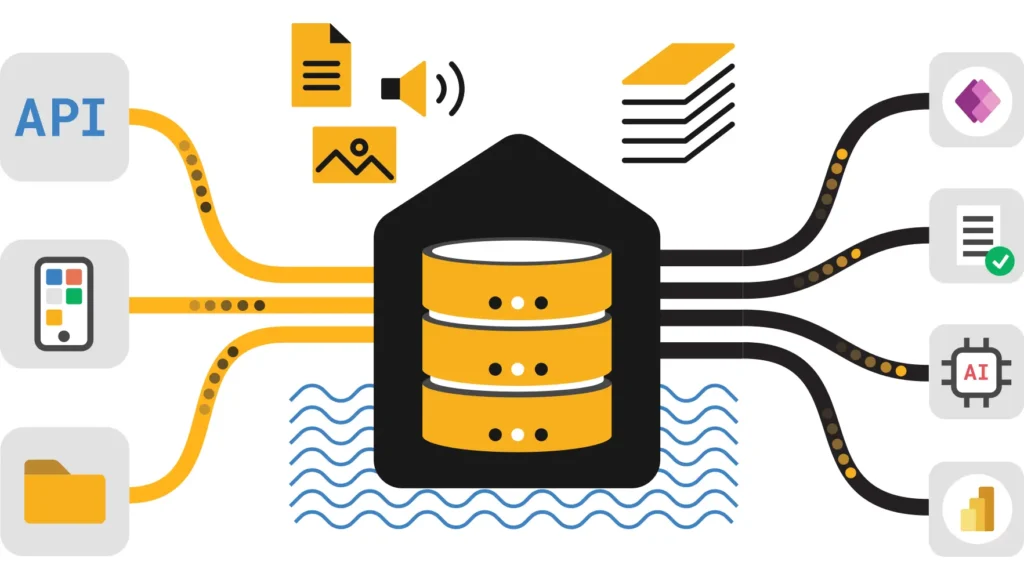
Microsoft Fabric is a SaaS (Software-as-a-Service) platform. Everything — Lakehouse (OneLake), Spark, SQL Warehouse, Dataflow Gen2, Eventstream, Real-Time Intelligence, Power BI — runs under a single control plane with shared governance and storage. You don’t provision separate services. One F-SKU covers all workloads assigned to that capacity.
Microsoft Fabric — SaaS Model
Single control plane. Unified storage via OneLake (Delta Lake). All workloads share one F-SKU capacity. Managed scaling, governance, and CI/CD. Low operational overhead. Less granular tuning.
Azure Synapse Analytics — PaaS Model
Modular components with explicit separation. Dedicated SQL pools with DWU-based scaling. Separate Spark pools. Fine-grained performance controls. Higher operational overhead. Maximum flexibility.
Storage Model
Fabric centers on Delta Lake in OneLake as the canonical storage layer — ACID transactions, time-travel, and table versioning by default for every item. Synapse historically uses dedicated SQL pools with columnar storage, and can integrate with ADLS Gen2 and Delta via Spark, but the integration is not native in the same way.
Microsoft’s corporate VP of Azure Data has publicly stated that Fabric is the next version of Azure Synapse. The architectural intent is clear: Fabric is not a competing product — it is the successor. The question for existing Synapse customers is not if to migrate, but when, and which workloads move first.
Microsoft Fabric vs Azure Synapse — Full Feature Comparison
| Capability | Microsoft Fabric | Azure Synapse | Verdict |
|---|---|---|---|
| Platform model | SaaS — unified control plane | PaaS — modular services | Fabric: lower ops overhead |
| Storage layer | OneLake (Delta Lake native, ACID, time-travel) | Dedicated SQL pools + ADLS Gen2 + Delta via Spark | Fabric: unified and simpler |
| SQL analytics | Fabric Data Warehouse (serverless, T-SQL) | Dedicated SQL pools + serverless SQL pool | Synapse: dedicated pools offer more tuning |
| Spark engine | Fabric Spark (managed, Delta native, Git/CI-CD) | Synapse Spark pools (configurable, .NET for Spark) | Both capable — see Section 03 |
| Data pipelines / ETL | Fabric Data Factory (Dataflow Gen2 + Pipelines) | Synapse Pipelines + ADF integration | Fabric: pipeline migration assistant now available |
| Real-time analytics | Eventstream + Eventhouse (KQL native) | Event Hubs + Stream Analytics + custom Spark streaming | Fabric: tighter native integration |
| Power BI integration | First-class citizen — same workspace as data | External — requires Power BI Service separately | Fabric: no context switching |
| Governance | OneLake Catalog + Purview native integration + OneLake data access roles | Purview integration via external configuration | Fabric: tighter by default |
| AI / Copilot | Copilot in notebooks, Dataflow Gen2, Power BI — Fabric-first rollout | No native Copilot integration | Fabric: AI-first platform |
| Git / CI-CD | Native Git integration on all items (default April 2026) | Limited — Synapse artifacts in Git, less comprehensive | Fabric: broader, more consistent |
| Billing model | Single F-SKU covers all workloads | Separate billing per component (SQL pools, Spark, Pipelines) | Fabric: simpler for mixed workloads |
| .NET for Spark | Not supported — migrate to Python or Scala | Supported (C# and F#) | Synapse: advantage for C#/F# teams |
| Dedicated SQL pools | No equivalent — Fabric Warehouse is serverless | Full DWU-based dedicated SQL pools | Synapse: advantage for isolated DWH scaling |
| External Hive Metastore | Internal HMS only (lakehouse-based) | External Hive Metastore (Azure SQL DB) + Catalog API | Synapse: advantage for Hive-dependent pipelines |
Spark in Microsoft Fabric vs Azure Synapse — What Changed
Per Microsoft Learn’s official Spark comparison documentation, the majority of Spark capabilities map directly between the two platforms. Spark-based workloads have the most straightforward migration path from Synapse to Fabric — far more so than SQL pool workloads.
Where Fabric Spark Wins
- Native Delta Lake integration: Every Lakehouse table is Delta by default — no configuration required.
- Git integration on notebooks: Notebooks and Spark job definitions are versioned in GitHub or Azure DevOps by default as of April 2026.
- SparkR support: Fabric Spark job definitions support SparkR; Azure Synapse does not.
- Built-in scheduling and retry policies: Spark job definitions include built-in scheduling and indefinite retry for Spark Structured Streaming jobs.
- High concurrency mode: Fabric provides high concurrency as an alternative to ThreadPoolExecutor — reduces cold start overhead for interactive workloads.
Where Azure Synapse Spark Still Has an Advantage
- .NET for Spark (C# and F#): Not supported in Fabric. Teams with C# Spark workloads must migrate to Python or Scala before moving to Fabric.
- UI-based JSON import/export: Available in Synapse for Spark job definitions; not available in Fabric — definitions are managed via Git.
- External Hive Metastore: Synapse supports external Hive Metastore backed by Azure SQL Database and Catalog API access. Fabric uses an internal lakehouse-based HMS only.
.NET for Spark is the Biggest Spark Migration Blocker
If your Synapse Spark workloads use C# or F# via .NET for Spark, this is a hard prerequisite: rewrite those jobs in Python or Scala before migrating to Fabric. There is no compatibility shim. Budget time for testing — Spark behavior can differ between Python and C# implementations in subtle ways.
SQL Workloads: Fabric Warehouse vs Synapse Dedicated SQL Pools
This is the area of greatest divergence between the two platforms and the most important factor for organizations with mature Synapse SQL investments.
Fabric Data Warehouse
Serverless T-SQL endpoint. Scales automatically — no DWU management. ACID transactions via Delta Lake. Integrated with OneLake and Power BI Direct Lake mode. Background operations get 24-hour CU smoothing. No dedicated isolated resource pool.
Synapse Dedicated SQL Pools
DWU-based dedicated scaling with predictable, isolated resource allocation. Mature, battle-tested for large-scale SQL DWH. Granular performance tuning (distribution, indexing, materialized views). Higher operational overhead — manual DWU management required.
For most BI-focused SQL analytics workloads, Fabric Warehouse is sufficient and simpler to operate. The case for keeping dedicated SQL pools in Synapse is narrow but real: workloads requiring guaranteed isolated compute, complex distribution strategies, or highly tuned materialized views that currently perform well on Synapse dedicated pools and would require significant re-engineering to replicate in Fabric.
Fabric Warehouse varchar(max) Limit
Fabric Warehouse supports varchar up to 16 MB — this is larger than some documentation suggests. Standard string columns work as expected. Verify the current supported data type limits on Microsoft Learn Data Warehouse data types before migrating schemas.
Where Microsoft Fabric Still Has Gaps vs Azure Synapse (June 2026)
Not all Synapse features are available in Fabric as of June 2026. Organizations relying heavily on any of these should maintain Synapse for those specific workloads while adopting Fabric for new development.
| Synapse Feature | Fabric Status | Recommended Action |
|---|---|---|
| Dedicated SQL pools (DWU-based) | No equivalent — Fabric Warehouse is serverless only | Keep on Synapse until workload is validated on Fabric Warehouse. Test performance with representative query patterns. |
| .NET for Spark (C# / F#) | Not supported | Rewrite in Python or Scala before migrating Spark jobs to Fabric. |
| External Hive Metastore (Azure SQL DB) | Not supported — internal HMS only | Evaluate whether lakehouse-based internal HMS covers your use case. If Catalog API is required, stay on Synapse. |
| UI-based Spark job JSON import/export | Not available | Use Git-based management in Fabric instead — Spark job definitions are stored as plain-text files. |
| Synapse Link (operational analytics) | Fabric Mirroring covers Azure SQL, PostgreSQL, MySQL, Snowflake, SAP, SharePoint | Evaluate Fabric Mirroring as the replacement. Most Synapse Link use cases are covered. See our Mirroring guide. |
When to Choose Microsoft Fabric vs Azure Synapse in 2026
Start with Microsoft Fabric When:
You’re starting a new analytics project with no existing Synapse investment.
Your team wants integrated UX — data engineering, Power BI, and pipelines in one workspace without context-switching between the Azure Portal and Power BI Service.
You want Copilot across notebooks, Dataflow Gen2, and Power BI — all Fabric-first.
Your workloads include Spark-based data engineering, real-time analytics (Eventstream/KQL), or self-service BI with Direct Lake.
Stay on Azure Synapse When:
You have heavily tuned dedicated SQL pools with complex distribution strategies that would require significant re-engineering.
Your Spark workloads use .NET for Spark (C#/F#) and rewriting them is not yet planned.
You require external Hive Metastore or Catalog API access that Fabric doesn’t support.
You have a working Synapse environment that meets current requirements — don’t migrate for its own sake.
The Recommended Pattern for Most Organizations
Run both in parallel. Start all new analytics workloads in Fabric. Keep existing Synapse workloads running. Build a migration roadmap for Synapse workloads based on feature availability and migration complexity. A phased approach takes months to years — that is expected and correct.
Migrating from Azure Synapse to Microsoft Fabric — What’s Available Now
Pipeline Migration Assistant — Public Preview (March 2026)
Per the official Fabric blog announcement (March 2026), Microsoft introduced the ADF and Synapse Pipelines Migration Assistant in public preview. It provides an assessment-first approach — compatibility check, supported activities, readiness report — before anything moves. When you proceed, it automatically migrates pipelines into Fabric Data Factory, converts linked services into Fabric connections, and disables triggers by default so you validate before activating. Available at no additional cost.
Migration Paths by Workload Type
- Synapse Pipelines → Fabric Data Factory Use the Pipeline Migration Assistant (public preview, March 2026). Assessment-first, guided, no-cost. Converts linked services to Fabric connections. Disables triggers by default for safe validation.
- Synapse Spark Notebooks → Fabric Notebooks Documented migration path on Microsoft Learn. Import notebook .ipynb files directly. Validate library dependencies — Fabric Spark runtime versions differ from Synapse. Remove .NET for Spark code first.
- Synapse Spark Job Definitions → Fabric Spark Job Definitions Per Microsoft Learn: supported file types (.py, .R, .jar) migrate directly. UI-based JSON import/export from Synapse is not available in Fabric — use Git-based management instead. SparkR is supported in Fabric, unlike Synapse.
- Synapse Dedicated SQL Pools → Fabric Data Warehouse No automated migration tool. Manual schema and data migration required. Use CETAS (Create External Table As Select) to export data from SQL pools to ADLS, then ingest into Fabric Lakehouse or Warehouse. Validate all stored procedures, distribution strategies, and materialized views.
- Synapse Link → Fabric Mirroring Fabric Mirroring covers the primary Synapse Link sources: Azure SQL, PostgreSQL, Cosmos DB (via Open Mirroring), and Snowflake. See our Data Mirroring guide for setup and limitations.
There is no single migration weekend for Synapse → Fabric. Every successful migration pattern involves running both platforms in parallel during transition — sometimes for months. The goal is to validate Fabric behavior on production-scale data before decommissioning Synapse, not to move fast.
Cost Comparison: Microsoft Fabric vs Azure Synapse
Direct cost comparison requires workload-specific modeling — the billing models are structurally different. Synapse charges per component: dedicated SQL pool DWUs, Spark pool vCores, pipeline runs, and storage separately. Fabric charges a single F-SKU capacity covering all workloads simultaneously, plus OneLake storage at $0.023/GB/month.
When Fabric Wins on Cost
- Mixed workloads: When you’re running Spark, SQL, Power BI, and pipelines simultaneously, Fabric’s all-in-one F-SKU avoids paying separately for each Synapse component.
- Power BI licensing: At F64+, Power BI Pro licences for viewers become optional — a significant saving for large organizations.
- Mirroring free storage: 1 TB free OneLake mirroring storage per CU purchased — F64 gives 64 TB free. No equivalent in Synapse Link.
- Operational overhead reduction: Fewer services to manage means fewer ops hours — an indirect but real cost factor.
When Synapse May Still Be More Cost-Efficient
- Isolated single-workload DWH: A single, highly active dedicated SQL pool at a known DWU level may be cheaper than sizing an F-SKU for that workload alone.
- Existing reservations: If you have active Synapse reserved capacity commitments, migrating mid-term wastes sunk cost.
Use our Microsoft Fabric Pricing Calculator to model your specific workload combination and compare the F-SKU total against your current Synapse bill.
Frequently Asked Questions
Official References & Related Guides
⚠️ Accuracy Disclaimer
This guide is verified against Microsoft Learn Fabric vs Synapse Spark comparison, the March 2026 Fabric pipeline migration blog post, and Azure Synapse Analytics documentation as of June 2026. Feature availability changes frequently — verify current status on Microsoft Learn before architecture decisions. UIG Data Lab is an independent publication, not affiliated with or endorsed by Microsoft Corporation.