Microsoft Fabric Production Stability: 2026 In-Depth Review
Most Fabric stability problems trace back to three things: capacity sizing decisions made before measuring actual workload, governance gaps that go unnoticed until an audit, and architecture choices that leave no isolation between production and development. This guide addresses all three — with what actually changed in 2026.
Microsoft Fabric production stability depends more on how you architect and operate it than on the platform itself. The 99.9% SLA covers core services, but throttling, governance gaps, and cross-workload resource contention are operational problems — not platform failures. Organizations that separate production and development capacities, monitor daily with the Capacity Metrics App, and govern through the OneLake Catalog Govern tab (which replaced the Purview Hub in January 2026) maintain reliable analytics environments with minimal unplanned downtime.
What Actually Determines Microsoft Fabric Production Stability
The platform SLA — 99.9% for core services — covers Microsoft’s infrastructure availability. It does not cover throttling from overconsumption, data quality failures from poor pipeline design, or governance incidents from misconfigured access controls. Those are operational problems, and they are the actual source of most stability incidents in production Fabric environments.
| Stability Factor | Platform Behaviour | Production Practice |
|---|---|---|
| Capacity Uptime | 99.9% SLA for core services (per Microsoft Online Services SLA, June 2026). Regional variance exists. | Deploy mission-critical workloads on dedicated capacities. Monitor with the Capacity Metrics App. Have a backup capacity available for critical workspace reassignment. |
| Throttling Risk | Progressive 4-stage throttling kicks in when capacity debt exceeds 10 minutes of future CU budget. Self-healing. | Size for average load. Separate production from development. Schedule background jobs off-peak. See our Capacity Optimization guide. |
| Pipeline Reliability | Data pipelines support retry policies, activity-level error handling, and timeout configuration. | Configure retry logic on every pipeline activity. Set sensible timeouts. Alert on failure — don’t poll manually. |
| Mirroring Stability | Supports Azure SQL, PostgreSQL, MySQL, Snowflake, SAP, SharePoint, and Open Mirroring partners. | Monitor CDC lag in the Mirroring Monitor Hub. Set alerts for lag above your SLA threshold. Start with small tables; validate before mirroring critical entities. |
| Dataflow Reliability | Dataflow Gen2 runs on Fabric compute with Git integration and CI/CD by default (as of April 2026). | Enable Fast Copy for eligible connectors. Disable staging for same-region structured sources. Monitor CU consumption per dataflow run. |
| Governance Posture | Purview built into Fabric. Security insights now in OneLake Catalog Govern tab (Purview Hub removed January 2026). | Review the Govern tab weekly. Track sensitivity label coverage and DLP policy gaps. Certify production assets in the OneLake Catalog before going live. |
The most common stability incident pattern: a development team’s large Spark job runs on the same capacity as production Power BI reports. The Spark job bursts, consumes future CU budget, and Power BI dashboards hit Stage 2 or Stage 3 throttling during the business day. The fix is a separate development capacity — not a larger production capacity. Isolation costs less than an outage.
Capacity Management for Production Stability
A Fabric capacity is not a server — it is a shared pool of Capacity Units that every workload draws from simultaneously. Managing that pool correctly is the single most impactful thing you can do for production stability.
The Correct Production Capacity Architecture
- Production capacity (F32–F64+): Business-critical Power BI reports, scheduled pipelines, mission-critical warehouses. Never share with development.
- Development/test capacity (F2–F4): Developer notebooks, pipeline testing, Dataflow Gen2 authoring. Isolated so failures here don’t touch production.
- VIP/executive capacity (optional, F8–F16): High-priority reports for leadership that must never experience throttling. Even small dedicated capacity provides complete isolation.
Pause and Resume — Know the Risk
Pausing a capacity saves cost during off-hours but carries one important risk: if the capacity has accumulated carryforward debt from burst operations, pausing triggers immediate billing for that debt. Pause only when the Capacity Metrics App shows minimal carryforward accumulation. Never pause a capacity that has been throttling.
Monitoring Production Capacity Health
- Capacity Metrics App: 14-day history of CU utilization, throttling events, and per-workspace consumption. Install from AppSource.
- Automated alerts: Set alerts at 80% sustained utilization and for any Stage 3+ throttling events. Don’t rely on manual checks.
- Weekly review cadence: After the first month, weekly reviews catch trends early. Monthly reviews miss problems until they become incidents.
For the complete throttling mechanics, smoothing windows, and burst factors, see our Fabric Capacity Optimization guide.
Stable Architecture Design for Enterprise Fabric Deployments
Architecture decisions made at the start of a Fabric deployment are difficult to unwind later. The patterns below reflect what production teams learn from their first year of operating Fabric at scale — and what they wish they’d done on day one.
Multi-Capacity Isolation
Production, development, and executive workloads on separate capacities. Each capacity has its own CU pool, throttling threshold, and billing boundary. Resource contention in development cannot propagate to production.
OneLake as the Single Storage Layer
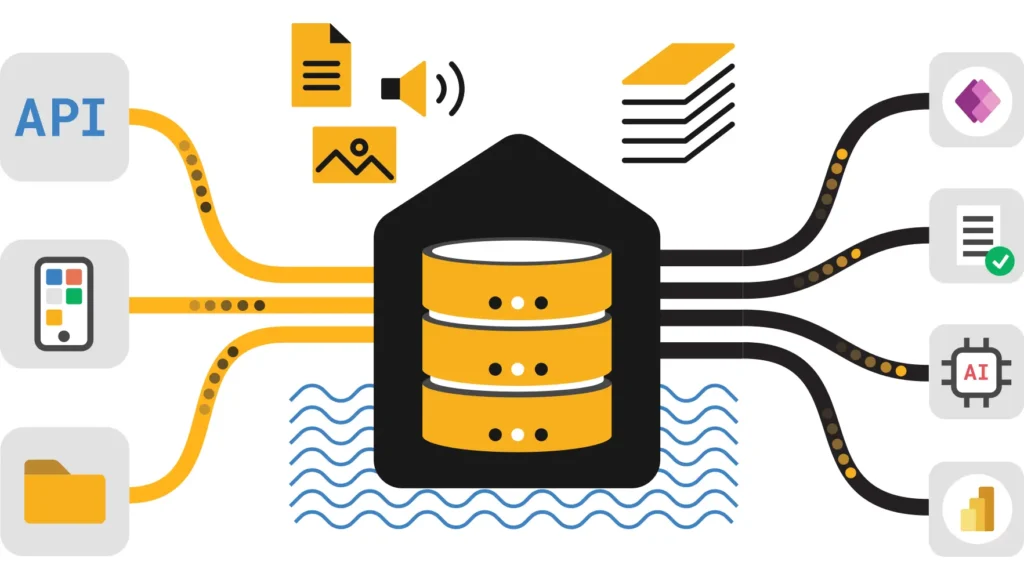
All Fabric items — Lakehouses, Warehouses, notebooks, semantic models — read from and write to OneLake. Zero-copy shortcuts allow data to be reused across workspaces without duplication. OneLake data access roles enforce security at table, row, and column level.
Private Endpoints for Sensitive Sources
For sources in VNets or private networks, use private endpoints or the Fabric VNet data gateway. As of Q1 2026, Eventstream also supports VNet source connectivity via an Azure Managed VNet bridge. Keeps sensitive data off public internet paths entirely.
Medallion Lakehouse Architecture
Bronze (raw mirrored or ingested data) → Silver (validated, enriched Delta tables) → Gold (curated serving layer for Power BI and ML). Each layer is a separate Lakehouse or Warehouse item. Raw data is never exposed directly to analysts.
Pipeline Reliability Patterns
- Retry logic on every activity: Network blips, transient source errors, and timeout events are routine. Every Data Pipeline activity should have a retry policy configured. Three retries with exponential backoff handles most transient failures.
- Failure notifications: Pipeline failures should send alerts to the responsible team immediately — not be discovered on the next manual check. Wire pipeline failure handlers to your team’s alerting channel.
- Idempotent writes: Design pipelines to be safely re-runnable. Use Delta MERGE rather than INSERT, and design notebook logic to handle reruns without creating duplicates. See our Mirroring guide for idempotent patterns.
Governance & Security for Microsoft Fabric Production Stability
Governance in Fabric is not a separate tool you bolt on — it is built into the platform. Microsoft Purview is natively integrated, sensitivity labels travel with data as it moves across items, and the OneLake Catalog is the single entry point for data discovery and governance administration.
Purview Hub Removed — January 2026
The Microsoft Purview Hub was permanently removed from Fabric at the end of January 2026. All security insights previously available there — sensitivity label coverage, DLP policy status, access controls, governance recommendations — are now in the Govern tab of the OneLake Catalog. Update your team’s bookmarks and monitoring workflows accordingly.
OneLake Catalog Govern Tab
The Govern tab provides Fabric admins with a centralized, action-oriented view of the organization’s governance posture. It includes three report sections:
- Manage your data estate: Inventory overview, capacities and domains, feature usage across the tenant.
- Protect, secure & comply: Sensitivity label coverage, DLP policies activated and scanned across workspaces.
- Governance recommendations: Specific, actionable suggestions for improving governance posture across items and workspaces.
Access Control — What Actually Works in Production
- Workspace roles for coarse access: Admin, Member, Contributor, and Viewer roles apply to all items in a workspace. Use them to control who can create, edit, or view at the workspace level.
- OneLake data access roles for fine-grained control: Table, row, and column-level security defined at the OneLake layer, enforced regardless of access path (SQL endpoint, Spark, Power BI). As of January 2026, these apply to all mirrored item types too.
- Sensitivity labels on items: Labels are applied to Lakehouses, Warehouses, reports, and datasets. They travel with data when exported — if someone exports a report to Excel, the sensitivity label persists on the file.
- Service principals via Azure Key Vault: Never hardcode credentials. All pipeline and dataflow connections should authenticate via Managed Identity or service principals stored in Key Vault.
Purview Integration for Enterprise Compliance
Purview and Fabric work together without custom integration. Per Microsoft Learn, the integration covers: Unified Catalog for data discovery across the estate, Information Protection for sensitivity labelling, Data Loss Prevention policies, Audit logging, Insider Risk Management, and governance for Fabric Copilots and data agents. For regulated industries (financial services, healthcare, public sector), this coverage makes Fabric a defensible choice for sensitive workloads.
The governance mistake most production teams make is treating the Govern tab as a one-time setup task. Governance posture degrades over time as new items are created, access is granted informally, and sensitivity labels are skipped on new datasets. The Govern tab’s data refreshes every time you open it. Make it part of your weekly team review — not something you check when an incident happens.
CI/CD & Git Integration for Production-Grade Deployments
Production stability requires that changes to pipelines, notebooks, dataflows, and semantic models go through a controlled promotion process — not direct edits in the production workspace. Fabric’s Git integration and Deployment Pipelines provide exactly this.
What Git Integration Covers (as of April 2026)
All new Fabric items include Git integration by default. Definitions are stored as plain-text files in GitHub or Azure DevOps — diffable, reviewable in pull requests, and rollbackable to any commit. This applies to Dataflow Gen2, Data Pipelines, notebooks, semantic models, and Eventstreams.
Fabric Deployment Pipelines
Deployment Pipelines promote items across Dev → Test → Production workspaces. Environment-specific Variable Libraries inject the correct source connections, database names, and configuration values at each stage — the M code and pipeline logic stay identical across environments, only the variables change.
Minimum CI/CD Setup for Production Stability
- All pipeline and notebook definitions committed to a Git repository — no direct production edits
- Deployment Pipelines with three stages: Dev, Test, Production
- Variable Libraries for environment-specific connection strings and parameters
- Pull request reviews required before promotion to Production stage
- Automated test runs (row count checks, schema validation) as part of the Test stage promotion gate
June 2026 Updates That Affect Production Stability
Eventstream Service Bus Connector — GA
The Azure Service Bus connector reached General Availability in June 2026. Now production-ready for order transactions, event-driven microservices, and workflow events streaming into Fabric for real-time analytics. Suitable for the most demanding enterprise scenarios.
Eventstream HTTP Connector Pagination
The HTTP source connector now supports pagination for REST APIs that return results across multiple pages. Previously, multi-page API responses required custom workarounds. Now handled natively in Eventstream.
Mirrored Database Change Feed → Eventstream
Row-level changes from Fabric Mirrored databases (with Extended Capabilities and Delta CDF enabled) now stream directly into Eventstreams. No custom Spark notebooks required. Discover in Real-Time Hub and connect in a few clicks.
Cross-Workload Governance Investments
June 2026 continues investment in data agents, real-time intelligence, and enterprise-ready governance across the platform. OneLake Catalog Govern tab with automated refresh is the production governance command center.
January 2026 Governance Change — Act on This
If your team still has bookmarks or runbooks pointing to the Microsoft Purview Hub, update them now. The Purview Hub was permanently removed at the end of January 2026. Navigate to the OneLake Catalog → Govern tab for all security insights, DLP status, and governance recommendations going forward.
Frequently Asked Questions
Official References & Related Guides
⚠️ Accuracy Disclaimer
This guide is verified against Microsoft Learn — Fabric Overview, Purview Fabric governance documentation, and the June 2026 Feature Summary. SLA figures reflect the Microsoft Online Services SLA updated June 2026. UIG Data Lab is an independent publication, not affiliated with or endorsed by Microsoft Corporation.