Microsoft Fabric vs Databricks (2026): Architecture, Governance, Pricing & Verdict
Both platforms run Spark, both store Delta, both claim the lakehouse title. The real differences sit in delivery model, BI integration, AI tooling, and what you pay when they’re idle. This guide covers all of it with the 2026 feature set — including Lakebase GA, Genie Code, Direct Lake maturity, Unity Catalog mirroring, and Fabric’s Iceberg interop.
Microsoft Fabric is the right platform for Microsoft-aligned enterprises with a Power BI footprint — it consolidates ETL, warehouse, BI, and real-time analytics under a single F-SKU bill, and Direct Lake gives Power BI sub-second performance without import refresh. Databricks is the right platform for data-engineering-heavy teams, multi-cloud mandates, and organizations training or fine-tuning LLMs at scale — its Photon engine, Lakebase (GA January 2026), and Genie Code (GA March 2026) are ahead of anything Fabric offers on the engineering side. Most Fortune 500 teams running both use the Mirrored Unity Catalog pattern — Databricks stays the engine of record, Fabric becomes the governed BI consumption layer.
Microsoft Fabric vs Databricks Summary
Platform-level snapshot for architecture leads and engineering directors evaluating both options in 2026.
| Dimension | Microsoft Fabric | Databricks |
|---|---|---|
| Delivery model | SaaS — zero cluster management, automatic upgrades | PaaS — customer manages clusters, runtimes, VNETs |
| Storage layer | OneLake — single tenant-wide Delta/Iceberg lake | ADLS / S3 / GCS — customer-owned, Unity Catalog governed |
| Governance | Microsoft Purview + OneLake security (table/column/row) | Unity Catalog — mature federation across clouds and workspaces |
| Power BI | Direct Lake — reads Delta Parquet directly, no import refresh | DirectQuery or Import — query latency + DBU cost per click |
| Compute engine | Polaris (Spark 3.5) + Starter Pools (5–15s cold start) | Photon (C++ vectorized) + DBR 18.x (Spark 4.1 in Beta) |
| AI / ML | Copilot, Microsoft Foundry integration, Azure OpenAI native | Mosaic AI, MLflow (creator), Genie Code GA, Lakebase GA |
| Streaming | Real-Time Intelligence — Eventstream, Eventhouse (KQL), Activator | Spark Structured Streaming + Lakeflow Declarative Pipelines |
| Multi-cloud | Azure-primary — external data via Shortcuts and Mirroring | Native AWS, Azure, GCP — unified control plane across clouds |
| Billing model | Capacity Units (CU) — reserved pool, pause/resume supported | DBU per second + cloud VM costs (separate bill) |
| Market position (Q3 2026) | 35,000 paid customers, $2B+ ARR, 60% YoY growth | Gartner Magic Quadrant Leader, 2025 CDBMS category |
Architecture: SaaS vs. PaaS
Advertisements
The delivery model difference is real, and it affects every other trade-off in this comparison. Fabric is SaaS — Microsoft manages clusters, runtime upgrades, and scaling automatically. Databricks is PaaS — the customer controls the infrastructure and pays accordingly.
Microsoft Fabric — Unified SaaS Platform
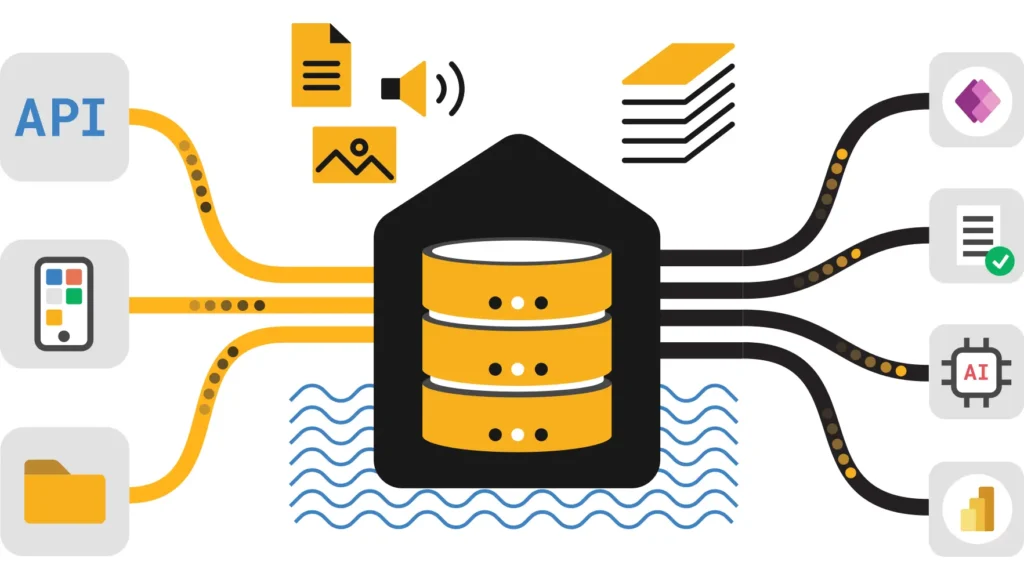
Fabric launched GA in November 2023 and combined seven previously separate Microsoft products into one SaaS experience: Data Engineering (Synapse Spark), Data Warehouse (Synapse SQL), Data Science (notebooks + MLflow), Real-Time Intelligence (formerly Synapse RTI + Data Activator), Data Factory (pipelines), Power BI (semantic models + reports), and Database Mirroring. All seven workloads share a single capacity bill and a single storage layer — OneLake.
As of Q3 FY2026, Fabric has 35,000 paid customers with revenue up 60% year-over-year. OneLake data stored in Fabric grew nearly 4× year-over-year in the same period, and over 15,000 customers now use both Fabric and Microsoft Foundry together.
OneLake now supports both Delta Lake and Apache Iceberg formats with general availability. Snowflake-managed Iceberg tables can be stored natively in OneLake with automatic bidirectional conversion. Zero-copy, zero-ETL interoperability with Snowflake, Databricks, SAP, Salesforce, and Dataverse is now in GA or public preview across all connectors.
Databricks — PaaS Lakehouse with Full Infrastructure Control
Databricks gives engineering teams control that Fabric’s SaaS model cannot match: VNET injection for customer-managed network security groups, LTS runtime pinning (you decide when to upgrade, not Databricks), and a unified control plane across Azure, AWS, and GCP from a single workspace. For regulated industries — banking, defense, healthcare — where a background platform update breaking a production pipeline is unacceptable, that control is not optional.
Databricks Runtime 18.0 went GA in January 2026, followed by DBR 18.1 (Spark 4.1 Beta) in February 2026. The LTS track means production workloads stay on a certified, stable version while early adopters test new runtimes in parallel.
Databricks runs the same job code on AWS, Azure, and GCP with a single control plane — you can move workloads between clouds without rewriting pipelines. Fabric’s answer to multi-cloud is Shortcuts and Mirroring, which virtualize data stored in AWS S3 or GCP GCS into OneLake without copying it. That works well for read access, but compute still runs in Azure. If your architecture requires identical execution on multiple clouds, Databricks is the only option here.
The SaaS vs. PaaS framing matters most during incidents. When a Fabric update changes Spark behaviour, every Fabric tenant gets it simultaneously. When a Databricks runtime update ships, teams on pinned LTS versions are unaffected until they choose to upgrade. For long-running production pipelines where stability is worth more than the latest features, that control has real dollar value. The right answer depends entirely on how your team weighs stability against maintenance overhead.
Security & Governance: OneLake vs. Unity Catalog
Both platforms have closed the gap here significantly in 2025–2026. The architectural difference is where governance lives: OneLake enforces security at the storage layer, Unity Catalog enforces it at the metadata layer.
OneLake Security (Fabric)
As of 2025–2026, OneLake security supports table, column, and row-level access control enforced across all Fabric engines — not just Power BI, but also Spark notebooks, the SQL analytics endpoint, and pipelines. The January 2026 feature update added ReadWrite folder-level permissions, meaning contributors can write data to specific folders inside a Lakehouse without needing full contributor access to the workspace. The OneLake catalog also introduced a Parent–Child item hierarchy, grouping connected items (Lakehouse + its SQL endpoint, Eventhouse + its KQL DBs) rather than listing everything flat.
Purview integration is built in — sensitivity labels applied in Microsoft 365 are inherited automatically across Fabric items with no additional configuration. For organisations already running Purview for M365 Information Protection, this is a material advantage.
Direct Lake mode does not currently support Lakehouses with OneSecurity (role-based access control) enabled. If you activate the OneLake data access preview on a Lakehouse, Power BI Direct Lake semantic models on that Lakehouse will fail with an access error and fall back to DirectQuery. As of March 2026, this is still unresolved in the GA path. Disable OneSecurity on lakehouses that serve Direct Lake models, or manage RLS at the semantic model level instead.
Unity Catalog (Databricks)
Unity Catalog is a mature, federation-first governance layer that manages permissions, lineage, and data discovery across all workspaces and clouds from a single interface. It offers fine-grained ACLs — row-level security, column-level masking, attribute-based access control (ABAC) — that persist regardless of which workspace or compute cluster runs the query. The April 2026 release added governed tags for consistent metadata enforcement across Unity Catalog objects, and SAP Business Data Cloud column-level sensitivity tags now sync directly into Unity Catalog for ABAC policy use.
The Discover page (February 2026) added AI-powered dataset recommendations, domain-based organization, and unified search across tables, dashboards, and Genie spaces in one interface — Unity Catalog’s answer to the OneLake catalog.
| Capability | OneLake Security (Fabric) | Unity Catalog (Databricks) |
|---|---|---|
| Row-level security | GA — enforced across all engines | GA — enforced across all engines |
| Column masking | GA | GA |
| Cross-cloud federation | Via Shortcuts / Mirroring (Azure-primary) | Native — AWS, Azure, GCP unified |
| Microsoft 365 label inheritance | Automatic via Purview | Requires additional Purview configuration |
| ABAC policies | Limited | GA — attribute-based access control |
| Direct Lake + RLS | Supported at semantic model level; OneSecurity blocks Direct Lake (known issue) | N/A — Power BI uses DirectQuery for Databricks |
The mirroring GA in July 2025 changed the governance comparison significantly. You can now mirror Databricks Unity Catalog into Fabric’s OneLake and apply OneLake security roles on top — table, column, and row level — without the data moving. Unity Catalog permissions do not carry over automatically; you reapply them in Fabric using Entra ID groups. For organisations running both platforms, that means two governance configurations to maintain — plan for it before the first production deployment.
Power BI & Direct Lake
If Power BI is your primary reporting layer, Fabric wins this section clearly. The architectural advantage is Direct Lake mode — and it is not a small difference.
Direct Lake — How It Works
Direct Lake mode allows the Power BI Analysis Services engine to read Delta Parquet files directly from OneLake memory. No import job, no scheduled refresh, no data copy into a proprietary format. Reports reflect data changes as soon as the ETL job finishes writing to the Delta table — latency is the time between the last table write and the next DAX query, not a refresh window.
Queries run against the same F-SKU capacity used for data engineering. There is no separate Premium capacity cost. The trade-off: Direct Lake shares capacity with your Spark workloads, so a heavy notebook run during business hours competes with report queries for the same CU pool. Capacity sizing has to account for both.
- Direct Lake silently falls back to DirectQuery when DAX queries use unsupported functions, when RLS/OLS is configured via OneSecurity (see Section 02), or when data volume exceeds the SKU memory limit
- DirectQuery mode incurs query latency and resource cost identical to a standard DirectQuery connection — the performance advantage disappears entirely
- There is no visible warning to end users when fallback occurs — it looks like a slow report, not an error
- Diagnose via Power BI Desktop Performance Analyzer or the Fabric Capacity Metrics app; look for DirectQuery storage engine events in trace logs
- See the Direct Lake fallback fix guide for the full diagnostic and resolution steps
Databricks + Power BI
Databricks connects to Power BI via DirectQuery or Import mode. DirectQuery works — it is the standard enterprise pattern for connecting a SQL warehouse to Power BI — but every user interaction triggers a query against a Databricks SQL warehouse, which consumes DBUs and adds network round-trip latency. Import mode is faster at query time but introduces the refresh window problem: data is as stale as your last scheduled refresh.
Databricks announced Genie Code support for importing Power BI and Tableau workbooks (Beta, April 2026) — it reads the file and builds an AI/BI Genie dashboard replicating the visualisations. This is Databricks’ answer to the BI migration question, but it produces a Genie dashboard, not a Power BI report. Organisations committed to Power BI as the consumption layer have no clean migration path off it into Databricks-native BI.
The Mirrored Unity Catalog feature changes the Databricks + Power BI story in an important way. You can now mirror Databricks tables into Fabric via zero-copy shortcuts and serve them via Direct Lake in Power BI — without moving data or rebuilding pipelines. Adecco Group is running this in production: Databricks stays the engineering layer, Fabric + Direct Lake is the BI consumption layer. For teams with mature Databricks pipelines and a Power BI user base, this hybrid is often the fastest path to Direct Lake performance without a full platform migration.
Compute Engines: Polaris vs. Photon
For raw Spark throughput on large-scale analytical workloads, Databricks has an advantage. For time-to-first-query and startup latency in an interactive analytics environment, Fabric is faster. They are optimised for different things.
Polaris — Fabric (Spark 3.5)
- Starter Pools reduce cold start to 5–15 seconds on warm pools — significantly faster than traditional cluster spin-up
- High Concurrency mode (January 2026) lets up to 5 independent Lakehouse jobs share one Spark session, cutting wait time and cost on smaller capacities
- V-Order write-time optimisation sorts data within Parquet files for faster reads across all Fabric engines
- Serverless Spark — no cluster configuration required, scales automatically
- Does not match Photon on CPU-intensive analytical joins at petabyte scale
Photon — Databricks
- C++ vectorized execution engine, not standard JVM Spark — built for speed on massive joins and aggregations
- Databricks Runtime 18.0 GA (January 2026), DBR 18.1 (Spark 4.1 Beta, February 2026)
- LTS runtime track — pin production workloads to a certified version; upgrade on your schedule
- Serverless Compute available — runs on Databricks’ infrastructure, no separate VM bill on Azure Databricks Serverless
- Significantly outperforms standard Spark for CPU-intensive vectorized workloads
Before High Concurrency mode, a single Lakehouse preview operation could hold a Spark session for up to 20 minutes, blocking other jobs on smaller F-SKU capacities. The new mode allows up to five independent Lakehouse jobs triggered by the same user in the same workspace to share one underlying Spark session. For interactive development on F4–F8 capacities, this removes the most common source of startup delays without upgrading capacity.
AI & Machine Learning: 2026 Feature State
Advertisements
Both platforms made major AI announcements in 2025–2026. The difference is depth: Databricks built its AI stack from the foundations of the ML lifecycle; Fabric is integrating Microsoft’s AI surface area — Copilot, Azure OpenAI, Foundry — into a unified data platform.
Databricks — Mosaic AI and Genie Code
Databricks is the creator of MLflow, the industry standard for ML experiment tracking, model registry, and deployment. That heritage shows: Mosaic AI Model Serving supports hosted endpoints for major foundation models including GPT-5.2 Codex (January 2026), Claude Sonnet 4.6 and Claude Opus 4.7 (February–April 2026), with pay-per-token Foundation Model APIs. Lakebase — a PostgreSQL-compatible operational database for AI agents with autoscaling, scale-to-zero, instant branching, and point-in-time recovery — reached GA in January 2026 (autoscaling GA February 2026). Genie Code went GA at FabCon 2026 (March 2026): it is an agentic data assistant deeply integrated with Unity Catalog that understands tables, columns, and lineage, and can explore data, train models, build pipelines, and create dashboards across notebooks, SQL, and AI/BI — including importing Power BI and Tableau files (Beta).
MLflow traces can now be stored in Unity Catalog Delta tables using OpenTelemetry format and queried via Databricks SQL — long-term retention, SQL access, Unity Catalog permissions, compatible with all OpenTelemetry clients.
Microsoft Fabric — Copilot and Foundry Integration
Fabric integrates Copilot directly into every workload: notebooks, Power BI authoring, the SQL analytics endpoint, and the OneLake catalog (one-click semantic model summaries, GA January 2026). Microsoft Foundry integration means prebuilt models and tooling for model development, deployment, and inference are available inside Fabric without additional service configuration. Over 15,000 customers now use Fabric and Foundry together, and 250+ are on track to process over 1 trillion tokens on Foundry this year.
For RAG patterns — building chatbots that query enterprise data in OneLake using Azure OpenAI and LangChain or Semantic Kernel — Fabric’s architecture is straightforward: all corporate data is already in OneLake, accessible to Azure OpenAI without custom ETL pipelines. Fabric also added operations agents and data agents (GA by Q1 2026) that automate routine data operations and enable natural-language access to governed data.
| AI Capability | Microsoft Fabric | Databricks |
|---|---|---|
| ML experiment tracking | MLflow (integrated) | MLflow (creator — deeper integration) |
| Model serving / endpoints | Azure ML + Foundry integration | Mosaic AI Model Serving — hosted endpoints, pay-per-token Foundation Models |
| LLM training / fine-tuning | Foundry (via Azure integration) | Mosaic AI — purpose-built for LLM pre-training and fine-tuning at scale |
| Agentic AI assistant | Copilot (embedded in all workloads) | Genie Code (GA March 2026) — agentic, UC-aware, builds pipelines and models |
| Operational database for agents | Not available | Lakebase (GA January 2026) — Postgres-compatible, scale-to-zero |
| Vector search | Azure AI Search integration | Mosaic AI Vector Search — built-in retrieval quality evaluation (April 2026) |
| RAG patterns | Native — OneLake + Azure OpenAI, no extra ETL | Supported via Mosaic AI and partner integrations |
Databricks leads on ML lifecycle depth, LLM training infrastructure, and agentic engineering tooling. Fabric leads on turnkey AI consumption — getting Azure OpenAI onto enterprise data with the least configuration. For teams building custom foundation models or running large-scale ML experimentation, Databricks is the correct platform. For teams deploying pre-built AI models onto governed enterprise data, Fabric’s architecture is simpler and faster to production.
Real-Time & Streaming Analytics
This section has changed the most since 2024. Fabric’s Real-Time Intelligence workload is now a serious competitor to Databricks for streaming analytics — it just requires a different mental model.
Microsoft Fabric — Real-Time Intelligence
Real-Time Intelligence (RTI) reached GA in 2025 and gives Fabric a complete streaming stack without writing Spark Structured Streaming code. The three components: Eventstream ingests from Azure Event Hubs, IoT Hub, Kafka, CDC sources, or custom REST endpoints and applies real-time transformations before routing. Eventhouse (backed by KQL / Azure Data Explorer) stores streaming data with sub-second query latency, time-series analysis, and anomaly detection. Activator closes the loop — define conditions on streaming data and trigger Power Automate flows, Teams messages, or pipeline runs automatically without custom alerting infrastructure.
The Eventhouse Endpoint for Lakehouse (November 2025) adds instant schema synchronisation between Lakehouse Delta tables and Eventhouse KQL databases — schema changes reflect within seconds, with KQL query acceleration via the Query Acceleration Policy for hot-cache eligibility on recent data.
Accelerated OneLake shortcuts in Eventhouse (January 2026) index and cache Delta/Iceberg tables in OneLake for performant KQL queries — you set a HotDateTimeColumn policy to define which data is cached based on recency.
Databricks — Lakeflow Declarative Pipelines
Databricks renamed Delta Live Tables (DLT) to Lakeflow Declarative Pipelines in 2025. The syntax and capabilities are identical — declarative pipeline definitions, automatic dependency resolution, expectations-based data quality, full lineage in Unity Catalog. For teams that built DLT pipelines, nothing changes. For teams evaluating Fabric, there is no equivalent: Fabric has no Lakeflow-equivalent declarative pipeline syntax. The closest Fabric options are Dataflow Gen2 (visual) or Spark notebooks (imperative).
| Streaming Scenario | Fabric Approach | Databricks Approach |
|---|---|---|
| IoT telemetry at millions of events/sec | Eventstream → Eventhouse (KQL) — no code required | Auto Loader → Lakeflow Declarative Pipelines |
| CDC from operational databases | Mirroring (Fabric) — near-real-time replication into OneLake | Lakeflow Connect — managed CDC ingestion with free tier (100M records/day) |
| Complex stateful stream processing | Spark Structured Streaming in notebooks | Spark Structured Streaming — deeper control, watermarking, exactly-once semantics |
| Real-time dashboards without Spark | Eventhouse + Real-Time Hub — sub-second KQL queries, no cluster management | Databricks SQL warehouse — requires DBU cost per query |
| Declarative pipeline syntax | Not available — no DLT equivalent | Lakeflow Declarative Pipelines (formerly DLT) — GA |
CI/CD & Developer Experience
The developer experience gap between the two platforms is real. Databricks is code-first and infrastructure-as-code-native. Fabric is low-code-accessible with code-first support layered on.
Databricks — Databricks Asset Bundles (DABs)
DABs let engineering teams define their entire Databricks infrastructure — jobs, pipelines, clusters, dashboards, model endpoints — as YAML configuration files, deployed via standard CI/CD tooling: GitHub Actions, Azure DevOps, GitLab. Local development via the Databricks VS Code extension is mature. The Databricks Assistant in Agent mode (January 2026) supports custom skills for domain-specific tasks, extending it beyond code completion into domain-aware engineering assistance. For teams running infrastructure-as-code across multiple environments, DABs are the current standard.
Fabric — Deployment Pipelines and Git Integration
Fabric supports Git integration with Azure Repos and GitHub — notebooks, semantic models, pipelines, and reports are versioned. Deployment Pipelines provide a visual interface for promoting content through Dev → Test → Prod. The limitation is merge conflict resolution: resolving conflicts in Fabric semantic models or Dataflow Gen2 items via Git diff is significantly harder than resolving standard code files, because many Fabric artifact formats are not human-readable JSON or YAML. For teams coming from a VS Code + Azure DevOps workflow, the transition requires adjustment.
Fabric semantic model files (.pbism, .bim) stored in Git are TMDL or TMSL format. Merge conflicts in complex semantic models with many tables and measures require manual resolution in the TMDL/TMSL files — there is no visual merge tool. Teams migrating from a Databricks code-first workflow to Fabric should plan for this when assessing engineering overhead. For notebooks and SQL scripts, the experience is straightforward standard Git.
Pricing: CU vs. DBU — What You Actually Pay
This is where most comparison articles get it wrong because they compare list prices without modelling usage patterns. The billing models are structurally different, and the cheaper platform depends entirely on your workload profile.
Fabric Pricing — Capacity Units (CU)
Fabric charges Capacity Units per second billed through an F-SKU Azure reservation. You buy a pool of capacity (F2 through F2048) and all workloads — ETL notebooks, SQL warehouse queries, Power BI report rendering, real-time intelligence — draw from the same pool. F-SKUs can be paused when not in use; you pay nothing while paused. F64 and above include free viewer access for Power BI report consumers (no Pro licence required per user).
| Scenario | Monthly Cost (Approx) | Notes |
|---|---|---|
| F64 PAYG — paused nights & weekends (~12hr/day weekdays) | ~$2,900 | All 6 Fabric workloads included. Verify at Azure Pricing Calculator. |
| F64 Reserved — 1 year, always-on | ~$5,000 | ~40% off PAYG 24/7 rate. Billed even when paused. |
| F64 PAYG — 24/7 no pause | ~$8,400 | Worst case — only justified for true 24/7 demand. |
Databricks Pricing — DBU + Cloud VM (Double Bill)
Databricks charges Databricks Units (DBU) per second of compute use, billed from $0.07 to $0.55 per DBU-hour depending on compute type and tier. In addition, you pay the underlying cloud provider separately for the VMs running the compute. On Azure Databricks, this means a Microsoft Azure bill for the VM instances plus a Databricks bill for the DBUs. On Databricks Serverless (SQL Serverless, Serverless Jobs), compute runs on Databricks’ infrastructure — you pay only DBUs, no separate VM bill.
A typical mid-market Databricks workload (10TB monthly processing, Premium tier) runs $5,000–$15,000/month in DBUs alone, before VM costs. Enterprise-scale workloads run $15,000–$50,000/month all-in. Serverless SQL can cut costs 30–50% for bursty analytical workloads versus provisioned clusters.
When teams build initial Databricks cost models, they estimate DBU costs but forget the VM bill. On Azure, you pay Databricks for DBUs and Microsoft for the underlying VM compute — two separate invoices. For a 10-node Standard_D8s_v3 cluster running 8 hours a day, the Azure VM cost alone can match or exceed the DBU cost. Always model both when comparing to Fabric’s all-inclusive CU price.
Fabric is cheaper for sustained, predictable workloads — especially when the same capacity serves ETL, warehouse queries, and Power BI reporting simultaneously. Databricks is cheaper for sporadic, bursty jobs where you pay only for seconds consumed and idle time costs nothing. The break-even point shifts significantly when you factor in Fabric’s pause capability and the Databricks VM double-bill. For Microsoft-aligned enterprises already paying for Power BI Premium, migrating to Fabric F-SKU typically shows 30–50% TCO reduction when the capacity consolidates ETL + BI into a single pool.
Hybrid Architecture: Better Together
The “pick one” framing is wrong for most Fortune 500 organisations. The pattern that keeps appearing in enterprise deployments — and was presented at FabCon 2026 by both Microsoft and Databricks — is a deliberate division of responsibility based on each platform’s strengths.
Mirrored Unity Catalog — The Standard 2026 Pattern
Mirroring Azure Databricks Unity Catalog to Microsoft Fabric went GA in July 2025. It works as follows: Fabric creates a Mirrored Azure Databricks Catalog item in a workspace, mirrors the Unity Catalog metadata structure (catalogs, schemas, tables), and creates OneLake shortcuts pointing at the same underlying Delta data in ADLS — no data copy, no ETL. Each mirrored item gets a read-only SQL analytics endpoint and a default Power BI dataset, ready for Direct Lake semantic models.
Updates in Databricks appear in Fabric immediately — the shortcuts point at live data. OneLake security roles (table/column/row level) can be assigned on the mirrored item independently of Unity Catalog permissions. The Adecco Group runs this in production: Databricks handles transformations and ML; Fabric + Direct Lake serves Power BI.
Reference Architecture
- Ingest and Transform (Databricks)Use Databricks Lakeflow Connect for managed CDC ingestion (free tier: 100M records/day/workspace). Run bronze-to-silver and silver-to-gold transformations using Lakeflow Declarative Pipelines or notebooks with Photon. Write final curated tables to ADLS Gen2 governed by Unity Catalog.
- Mirror into Fabric (OneLake)Create a Mirrored Azure Databricks Catalog item in a Fabric workspace. Fabric mirrors UC metadata and creates OneLake shortcuts to the curated Delta tables — zero data duplication, near-real-time updates. Assign OneLake security roles using Entra ID groups.
- Serve in Power BI (Direct Lake)Build Direct Lake semantic models over the mirrored tables. Power BI queries read Parquet files directly from OneLake — no scheduled refresh, no import job, no additional compute cost beyond the F-SKU. End users see data that is as fresh as the last Databricks pipeline run.
- Extend with Fabric Workloads (Optional)Add Fabric Real-Time Intelligence for streaming dashboards, Fabric Data Factory for additional orchestration, or Fabric Data Activator for threshold-based alerting — all sharing the same OneLake data and F-SKU capacity pool.
The Unity Catalog mirroring GA in July 2025 is the most important interoperability development in the Fabric vs. Databricks story — more important than any feature comparison. It removes the binary choice for most enterprise teams. Organisations that spent years building Databricks pipelines now have a clean path to Direct Lake Power BI performance without rebuilding anything. The question is no longer which platform to run — it is which platform owns which layer of the stack.
Who Should Use What
Platform decisions go wrong when teams pick based on feature lists rather than their actual skill set, ecosystem, and workload type. The clearest way to frame it:
Microsoft Fabric — Right Choice For
- Organisations already invested in Microsoft 365, Azure, and Power BI — the integration removes friction that Databricks cannot match
- BI-heavy teams that want Direct Lake performance without managing clusters or refresh schedules
- Mixed teams with analysts, business users, and data engineers sharing a single platform — Dataflow Gen2 and Fabric notebooks serve both audiences
- Enterprises consolidating multiple Azure services (Synapse, ADF, Power BI Premium) into one bill
- Teams building RAG applications or AI agents on enterprise data — OneLake + Azure OpenAI integration is the simplest path
Databricks — Right Choice For
- Data engineering teams who write Python and Scala daily and need Photon performance, LTS runtime pinning, and VNET-level security control
- Multi-cloud architectures where identical workloads need to run on AWS, Azure, and GCP
- ML-heavy organisations running custom model training, fine-tuning, or large-scale feature engineering — Mosaic AI and Lakebase are purpose-built for this
- Teams with mature DLT / Lakeflow Declarative Pipeline investments — no equivalent exists in Fabric
- Regulated industries (banking, defense) requiring LTS runtime stability and VNET injection for compliance
When Not to Use Fabric
| Scenario | Why Fabric Is Wrong Here | Better Option |
|---|---|---|
| LLM pre-training or large-scale fine-tuning | Fabric has no GPU cluster management; Foundry integration handles inference, not training at scale | Databricks Mosaic AI |
| Multi-cloud execution (same code on AWS + Azure) | Fabric compute runs in Azure only — external data via Shortcuts is read-only | Databricks (native AWS/Azure/GCP) |
| VNET-injected compute with strict NSG rules | Fabric is managed SaaS — no direct VNET injection for Spark compute | Databricks PaaS with VNET injection |
| Declarative pipeline syntax (DLT-style) | No Fabric equivalent — Lakeflow Declarative Pipelines are Databricks-only | Databricks Lakeflow Declarative Pipelines |
| GCP-primary data estate | Fabric is Azure-primary — GCP data accessible via Shortcuts but compute stays in Azure | Databricks on GCP |
Frequently Asked Questions
Feature descriptions and pricing figures are based on official Microsoft Learn documentation, Databricks release notes, and Microsoft earnings disclosures verified through June 2026. Platform capabilities change with each monthly release cycle — verify specific features at learn.microsoft.com/fabric and docs.databricks.com before architecture decisions. Pricing figures are indicative — verify current rates at the Azure Pricing Calculator and Databricks pricing pages. UIG Data Lab is an independent publication, not affiliated with or endorsed by Microsoft Corporation or Databricks, Inc.