Microsoft Fabric Interview Questions
Complete 7 Pillar Guide (2026)
The definitive resource for Data Engineers and Architects. Master OneLake, Direct Lake, Spark, and Real-Time Intelligence with 250+ expert-verified Microsoft Fabric Interview Questions.
What are the top Microsoft Fabric interview questions?
The most common Microsoft Fabric interview questions focus on the unified SaaS architecture, specifically the “One Copy” feature of OneLake and the performance benefits of Direct Lake mode in Power BI. Candidates are expected to troubleshoot Spark OOM errors, explain F-SKU capacity smoothing, and demonstrate knowledge of T-SQL Warehouse limitations compared to Azure Synapse.
If you are preparing for a role in modern data analytics, mastering Microsoft Fabric interview questions is no longer optional—it is essential. As organizations aggressively migrate from Azure Synapse and Databricks to this unified SaaS ecosystem, they need professionals who understand more than just basic SQL. They need architects who can design cost-effective, scalable solutions.
This guide is not a random list of questions. It is a comprehensive syllabus designed to take you from basic definitions to advanced, scenario-based troubleshooting. We integrate real-world fixes found in our Microsoft Fabric Tutorial Series to ensure you aren’t just memorizing definitions, but learning how to solve production issues.
💡 Thinking about starting a small side income online?
Many creators start with simple tools and workflows — no investment required.
See how creators do it → CreatorOpsMatrix.comWhat You Will Master
We have structured this hub into 7 strategic pillars. By the end of this guide, you will be able to answer scenarios regarding:
- Core Architecture: Explaining OneLake, Shortcuts, and Domains to C-level executives.
- Data Engineering: Troubleshooting Spark OOM errors and optimizing shuffle partitions.
- Data Warehousing: Migrating T-SQL stored procedures from Synapse to Fabric.
- Real-Time Analytics: Using Eventstreams and KQL for sub-second reporting.
- Power BI: Managing Direct Lake fallback and optimizing semantic models.
- Governance: Securing data with OneLake roles and managing F-SKU capacity costs.
1. Architecture & OneLake
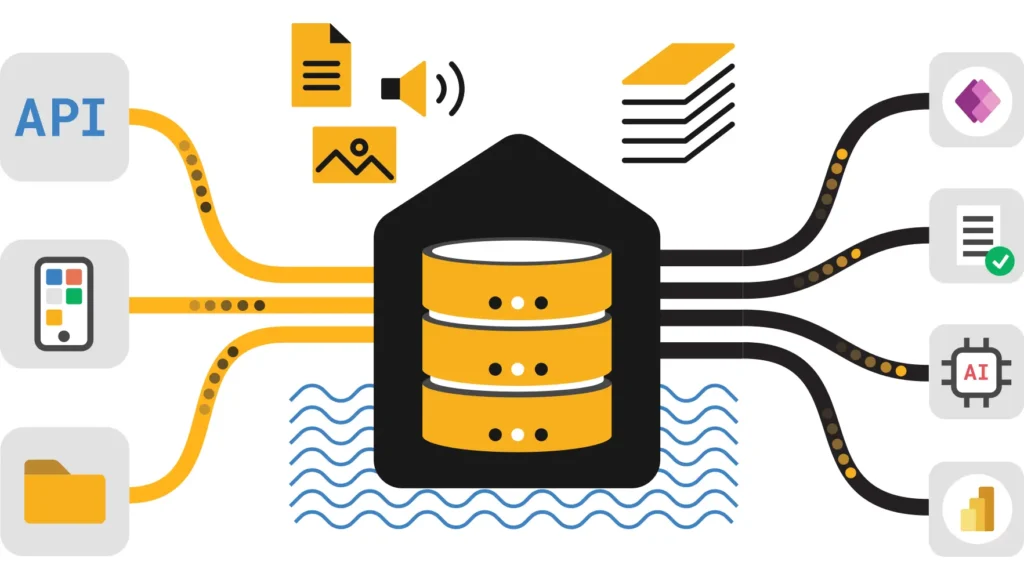
Architecture is the foundation. Recruiters will test your understanding of how Fabric virtualizes storage to eliminate silos. Articulate the difference between physical data movement and logical data virtualization.
🟢 Fundamentals
- OneLake: Explain the “OneDrive for Data” concept and unification.
- Shortcuts: When to use a Shortcut versus a Pipeline?
- Domains: Organizing data mesh architectures using Domains.
🔴 Scenarios
- Mirroring: Mirroring Snowflake without ETL tax.
- Multi-Cloud: Reporting on AWS S3 data without egress fees.
- Migration: Fabric vs. Databricks comparison.
2. Spark & Data Engineering
Data Engineers face strict scrutiny on PySpark optimization and memory management. Understand Spark Shuffle Partitions tuning.
🟢 Fundamentals
- Lakehouse vs Warehouse: The definitive decision matrix.
- Spark Pools: Starter Pools vs Custom Pools.
- Notebooks: Using `mssparkutils` for orchestration.
🔴 Scenarios
- V-Order: Optimizing for Direct Lake performance.
- OOM Errors: Fixing Py4JJavaError and memory crashes.
- Environments: Managing private PyPI libraries.
3. Data Warehouse (SQL)
Transitioning from Synapse? Understand the separation of compute and storage and T-SQL limitations in the Fabric Warehouse.
🟢 Fundamentals
- T-SQL Surface: Unsupported commands (e.g., Identity Columns).
- SQL Endpoint: Read-Only Endpoint vs Full Warehouse.
- Loading: Using `COPY INTO` for speed.
🔴 Scenarios
- Performance: Warehouse Optimization via Result Set Caching.
- Cross-Querying: Joining Lakehouse and Warehouse tables.
- Migration: Synapse to Fabric migration steps.
4. Data Factory (ETL)
Master the choice between Data Pipelines (orchestration) and Dataflow Gen2 (low-code transformation).
🟢 Fundamentals
- Decision: Pipelines vs Dataflow Gen2.
- Fast Copy: Accelerated ingestion architecture.
- Gateways: Using Data Gateways for on-prem access.
🔴 Scenarios
- Dynamic Pipelines: Parameterization and notebooks.
- Troubleshooting: Fixing Error 20302 and CSV BOM issues.
- Deployment: CI/CD for pipelines.
5. Real-Time Intelligence
Streaming data is essential. Learn Eventstreams, KQL Databases, and Data Activator for sub-second analytics.
🟢 Fundamentals
- Eventstreams: Ingestion without code.
- KQL: Basic Kusto query syntax.
- Reflex: Data Activator triggers.
🔴 Scenarios
- Storage Policy: Managing Hot Cache vs Cold Storage.
- Derived Streams: In-flight aggregations.
- Architecture: Fabric vs Azure Stream Analytics.
6. Power BI & Direct Lake
Direct Lake allows Power BI to query OneLake files directly. Learn to prevent Direct Lake fallback.
🟢 Fundamentals
- Direct Lake: “Zero Copy” architecture explained.
- Semantic Models: Default vs Custom models.
- Migration: Premium to Fabric strategy.
🔴 Scenarios
- Optimization: Reducing column cardinality.
- Composite Models: Mixing storage modes.
- AI: AI-Ready data modeling.
7. Governance & Security
Understand the layered security model: RBAC, Item Permissions, and Purview integration.
🟢 Fundamentals
- Security Layers: Workspace Roles vs OneLake Roles.
- Lineage: Tracking flow with Purview.
- Domains: Federated governance organization.
🔴 Scenarios
- CI/CD: Deployment Pipelines and Git.
- Network: Managed Private Endpoints.
- Costs: Capacity Optimization.
🧪 How to Answer Scenario-Based Questions (STAR Method)
Senior roles often require you to troubleshoot live production issues. Use the STAR framework:
💰 Fabric Capacity & Pricing Strategy
One of the most complex topics in interviews is estimating F-SKU costs vs. Legacy Power BI Premium. Architects must calculate the required CU (Capacity Units) and understand Bursting vs. Smoothing.
We have built a dedicated tool to help you model these costs:
Fabric vs. The Competition: Technical Comparison
Architects must justify platform choices. Here is a quick reference for comparison questions.
| Feature | Microsoft Fabric | Snowflake | Databricks |
|---|---|---|---|
| Architecture | Unified SaaS (OneLake) | Decoupled Storage | Lakehouse |
| Power BI | Direct Lake (Zero Copy) | DirectQuery (Slower) | DirectQuery (Slower) |
| Pricing | Unified Capacity (F-SKU) | Credits | DBUs |
| Sharing | OneLake Shortcuts | Secure Sharing | Delta Sharing |
| Review | View Analysis | View Analysis | View Analysis |
Note: Also consider how Fabric compares to Google’s offering in our Fabric vs BigQuery review.
Frequently Asked Questions
Is Microsoft Fabric replacing Azure Synapse Analytics?
Fabric is the evolution of Synapse. While Synapse is not being “killed” immediately, all new innovation (Copilot, Mirroring, Direct Lake) is exclusive to Fabric. Most enterprises are actively planning migration strategies. See our Fabric vs Synapse comparison.
Do I need to know Spark to work in Fabric?
It depends on your role. Fabric supports a “No-Code” path via Dataflow Gen2 and a “Low-Code” SQL path via the Warehouse. However, for advanced data engineering and complex transformations, Python/Spark is highly recommended.
Are these questions relevant for the DP-600 Exam?
Yes. The DP-600 “Implementing Analytics Solutions Using Microsoft Fabric” exam covers all 7 pillars mentioned here. Our “Intermediate” and “Advanced” questions are specifically aligned with the exam’s case study format.
Ready to Start Your Preparation?
Begin with the most fundamental topic that appears in 80% of interviews.
Start Architecture Questions →